
We lived on the farm until I was six years old. Dad sold all the animals and equipment, but he kept his milk trucks. The milk routes were one of the main reasons we moved — now he had access to two creameries instead of just one.
We moved to a new town, where I started school. Learning to read was thrilling, and it remains one of the great joys of my life. I remember Dick and Jane, and Spot and Puff, with deep fondness.
Everything was different there — city streets instead of gravel roads. We brought Brownie, of course, but a city ordinance meant he had to be tied up. We lived on a highway at the edge of town, and our small yard was a poor substitute for the acres of farmland he once roamed.
Mom and Dad said it wasn’t fair to keep him tied. He was sad — a farm dog, after all, used to chasing rabbits and running through open pastures. So Dad found him a home on a farm belonging to a good customer on one of his milk routes. I was sad, too. I missed him terribly. But Dad said Brownie was happier there, and that gave me comfort.
Over the next two years, we moved several more times to accommodate Dad’s changing business. Near the end of my third-grade year, Dad sold the milk trucks, found a better job, and purchased Mom’s childhood home in a small rural village only a few miles from the farm.
Soon after, Mom enrolled me in school — the one I came to think of fondly as The Little Red Schoolhouse. It was the same country school that Mom and her eight brothers and sisters had attended before me.
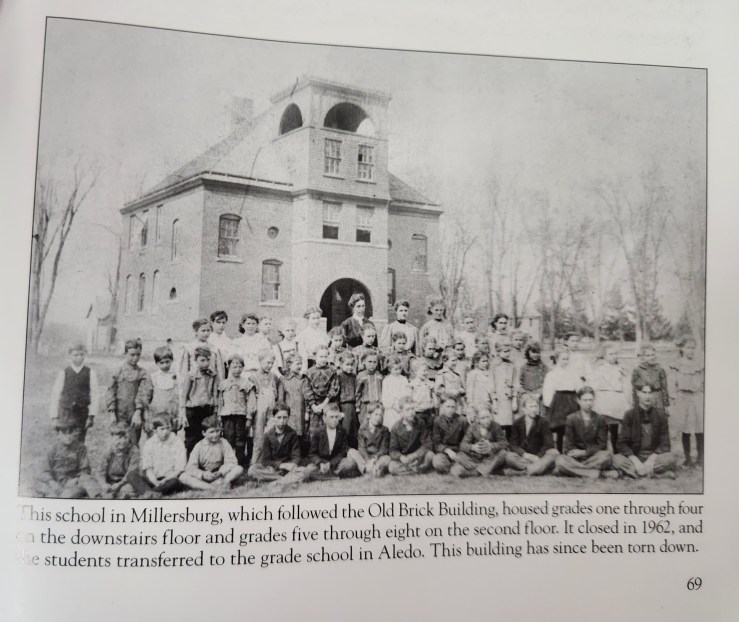
Millersburg School building, which housed grades 1–8 (later
1–6) before closing in 1962. Historic photo — not my class.
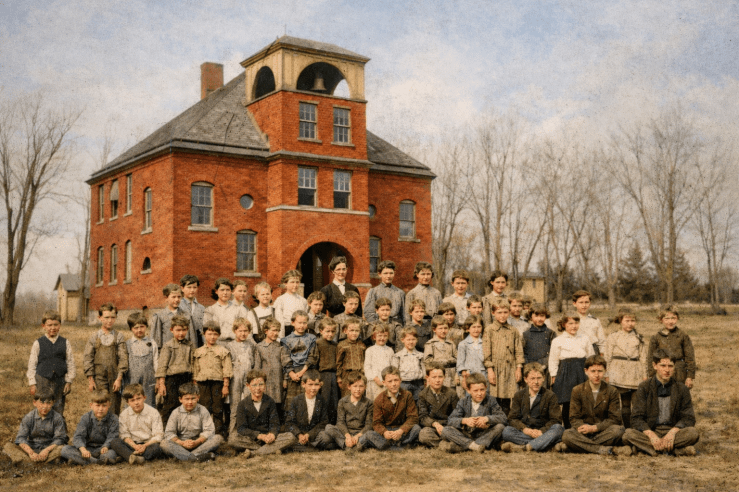
The entire school, grades 1–6, fit into two classrooms. Most grades had six to eight students. Some had fewer. When I was in fifth grade, there were only four children in fourth.
It was small in a way that felt personal.
 Through My Eyes, Gently