Mom’s Four Day Make Ahead Cake

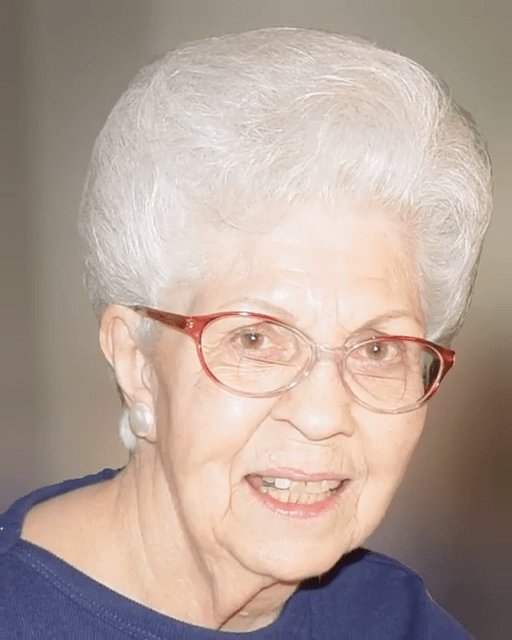
Mom was born at home on June 3, 1928—though Mercer County recorded it as June 2. Grandma always said the county was wrong. The reason, as I was told years ago and had almost forgotten, is that Grandma went into labor on June 2 but didn’t deliver until after midnight. So the county may have written down when it started… but we go by when she actually arrived. June 3 it is.

In honor of my mom’s birthday, I am sharing her favorite cake recipe, told exactly in her own words. 

She brought this cake to all of our family picnics, and there was never a single piece left over. Many have asked for her recipe over the years. 

Family members were always quick to ask if she had brought their favorite cake. She never disappointed. I think she would like knowing others can now enjoy it, too.

I’ve kept her wording exactly as she wrote it, including her name attached to the recipe. 

It feels right to share this today, as it would have been her 98th birthday.

I hope you love it as much as we always did. 

Four-Day Make Ahead Cake. (Elaine Stegall)

This is a wonderful cake that is so easy to make and one of my favorites. You can make the cake on Wednesday and take it on a picnic or anywhere else on Sunday! I like the convenience of being able to make it days ahead of time! If I have had some left over it has even lasted a week and is still delicious. This is a cake that MUST be kept refrigerated. 

CAKE:

1-18 oz. pkg. Devil’s food cake mix

1 cup water

1/3 cup oil

3 eggs

FILLING AND TOPPING:

2 cups or 16 oz. carton of dairy sour cream

1 cup sugar

3 cups of coconut

8 oz. container frozen Cool Whip…thawed or 3½  cups

Heat oven to 350 degrees F. Grease and flour two 8″ round cake pans. In a large bowl, blend all cake ingredients at low speed until moistened. Beat for 2 minutes at highest speed and pour into prepared pans. Bake for 30 to 35 minutes until cake is done in the middle. Cool cake in pans for 15 minutes … then turn out on to cooling racks or onto waxed paper until completely cool. Then split each layer in half with a piece of thread or dental floss and set aside. Separate layers onto four waxed papers or the cooling racks.

In a large bowl, combine sour cream and sugar. Gently FOLD in coconut and whipped topping. Fill and frost layers just as you would any cake. Garnish as desired. Store in a cake safe in the refrigerator. Enjoy!
Tweety Bird

My paternal great-grandmother raised parakeets.

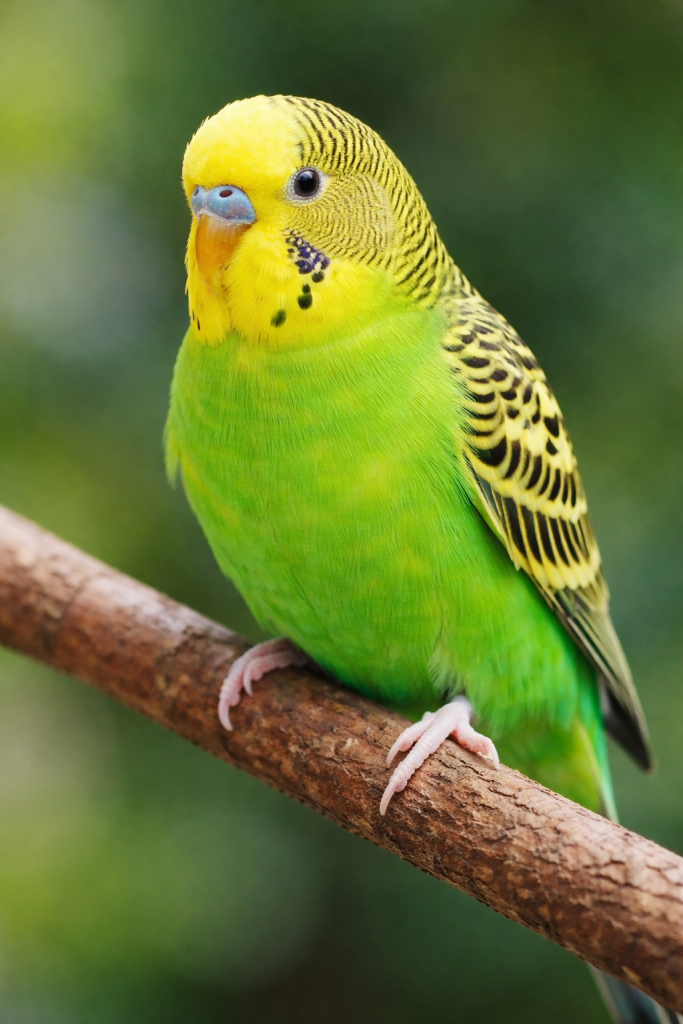
Tweety Bird…Not the original, but they look alike.

Whenever we went to her house, I would stand beside the bird cage and watch them. They fascinated me. It was the only time I ever got to observe birds up close.

One day, Grandma ‘Rene — her name was Irene, but everyone in the family called her Grandma ‘Rene — asked Monty and me if we would like to take one home.

Of course we said yes! We were so excited.

Given Mom’s slight aversion to birds, she was less enthused, but she allowed it.

Grandma gave us a cage, and we took him home.

Monty and I named him Tweety Bird after the cartoon character.

Cleaning the cage fell to Mom. She was an excellent housekeeper, so she cleaned it often. When the weather was nice, she took the cage outside and cleaned it on the sidewalk.

The last time she cleaned it… was the last time she cleaned it.

She had set the cage down on the sidewalk and slid the removable bottom out so she could clean it properly.

Unfortunately, she forgot to slide it back in before she picked up the cage.

Before she could react, Tweety Bird saw his opportunity — and he was a caged bird no more.

Mom said he flew up into the tree by the back door, but there was no way she could catch him.

He soon flew away, never to be seen again.

I think she felt bad when she had to tell us what happened when we came home from school.

We knew it was an accident, and she really did feel bad — but we couldn’t resist teasing her that we thought she did it on purpose because we knew she wasn’t fond of birds.

The Turtle in the Truck

My parents grew up during the Great Depression. Dad grew up on a farm where it was common to eat what you could raise or hunt.

Mom, having grown up in the same era, understood this in a way we might find a little more difficult today. I know Dad brought her rabbit, squirrel, and occasionally had her cook him a mess of frog legs.

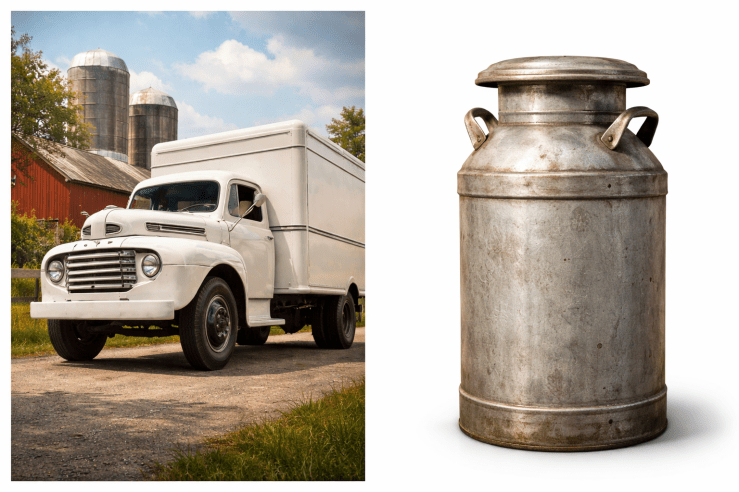
One day, when Mom was running the Kewanee milk route alone, she got quite a surprise when one of Dad’s “acquisitions” crawled out from under the seat of the milk truck.

The acquisition?

A soft-shelled turtle—that Dad had intended to make into turtle soup.

Since I wasn’t there and only heard the story later, I can only imagine the look on my mother’s face.

If I’ve given you the impression that she didn’t like animals, that’s not strictly true. She did—but mostly puppies and kittens. She didn’t like unwelcome surprises, and this one definitely qualified.

I don’t know whether she was driving when it happened or if she had already stopped at the next farm.

I only know that she got out of the truck and refused to get back in until the turtle was gone.

The farmer at the stop had to remove it for her. Mom wasn’t about to touch that turtle, and she made it very clear she wasn’t getting back into the truck until it was gone.

The farmer ended up with the turtle.

Dad missed having turtle soup—

…and so did the turtle.

The Lawn Chair Incident

In the summer and on Saturdays, my brother and I usually went with Mom when she ran the milk route for Dad.

It wasn’t unusual for them to stop for a little while to chat with the people they had become friends with, although they couldn’t stay long because the milk trucks in those days were not refrigerated.

One afternoon, Mom stopped to visit with a farmer and his wife. She went inside the house, but Monty and I stayed outdoors.

It was a beautiful day—warm, with blue skies and plenty of sunshine. We decided to sit in the folding lawn chairs under a shade tree.

I don’t remember what we were talking about, but Monty sat in his chair with his long legs touching the ground. My legs were much shorter, so I sat on the edge of the chair, swinging my feet.

That’s when disaster struck.

My position on the chair and the motion of swinging my feet caused it to fold up—catching my ring finger on my right hand between two pieces of metal. My weight pressed down hard on my smashed finger.

I started screaming at the top of my lungs.

Monty ran to get Mom, but he didn’t make it as far as the house before all three adults came tearing out and rushed to my side.

The farmer tried to unfold the chair, but he couldn’t. He grabbed some tools to take it apart, but he became frantic—probably because I was still screaming.

He partially took the chair apart… and partially ripped it apart.

I heard Mom say something about not ruining his chair, and he said he didn’t care. There were some curse words in there too, but I don’t remember what they were.

The only choice was to take me to the hospital.

Since Mom’s only transportation was the milk truck, the farmer bundled us into his car after his wife gave Mom a white cotton dish towel to wrap around my finger.

The only access to the highway to Hammond-Henry Hospital in Kewanee was a narrow gravel road with long, steep hills.

The farmer was in a hurry, so he drove as fast as he safely could.

I had stopped screaming once my finger was released from the chair, but now I was sobbing.

I sobbed all the way up the first hill…

…and laughed all the way down it.

The sudden drop always made me laugh.

As soon as we started up the next hill, I cried again—then laughed all the way down.

I think there were three hills in all, and it happened every time.

When we finally ran out of hills, I cried all the way to the hospital.

Fortunately, my finger wasn’t broken. The doctor bandaged it and sent me home.

After taking us back, Mom finished the milk route, although I don’t remember the rest of it.

It didn’t take long for me to realize that if I let my arm drop to my side, my finger started to throb—so I held it close to my chest for the rest of the afternoon.

When we got home, Mom made a sling for me out of a dish towel.

I was pretty proud of that sling.

To this day, that same finger is still slightly smaller than the ring finger on my left hand. It’s less noticeable now, and I doubt anyone else would see it…

…but I do.

Because I know what caused it.

No Brakes on Main Street

Mom was running the Kewanee milk route for Dad one day, picking up milk in big heavy cans and hauling them to the Galva Creamery Company. Dad had a deal worked out with the farmers so they loaded the cans for her. When Dad ran the route, he usually helped them.

Monty and I were with her that day. We had been singing songs like we usually did. Our favorites were The Marine’s Hymn and The Caissons Go Rolling Along.

Suddenly, Mom stopped singing and told us to get down on the floor. She didn’t shout, but we could tell by the tone of her voice that she meant business. We didn’t question it—we got down immediately.

We asked her what was wrong.

“The engine died,” she said. “When the engine dies, the air brakes don’t work.”

I had been looking through the windshield just before she told us to get down. We were a little less than halfway down a hill.

The light at the bottom of the hill turned red.

That meant the cross traffic had the right of way.

I remember seeing the cars sitting there at the intersection.

I’m guessing the drivers saw the crazy people in the big runaway milk truck coming down the hill a little too fast and decided it might be best to stay right where they were.

Mom gripped the big steering wheel and kept the truck pointed straight down the hill.

The truck was heavy with a full load of milk cans. Once it started downhill, there was no way to stop it without brakes.

My stomach did that flip-flop thing it does when you go down a hill too fast. Usually it made me laugh.

This time it didn’t.

It all happened so fast. We made it through the stoplight without mishap. We were still rolling, but Mom finally got the engine started again and pulled off to the side of the highway.

We waited there for a few minutes. Then Mom pulled back into traffic and continued on to the creamery in Galva.

I was only six years old, but that is something I will never forget.

Never Far From Home

From the summer before I started school, until the spring of my third grade year, I attended five different schools.

One place we stayed a couple of years. Three others we stayed a very short time, hardly more than a few months. In the third grade alone, I attended four different schools. I never questioned why until much later in life, when it was too late to ask anyone.

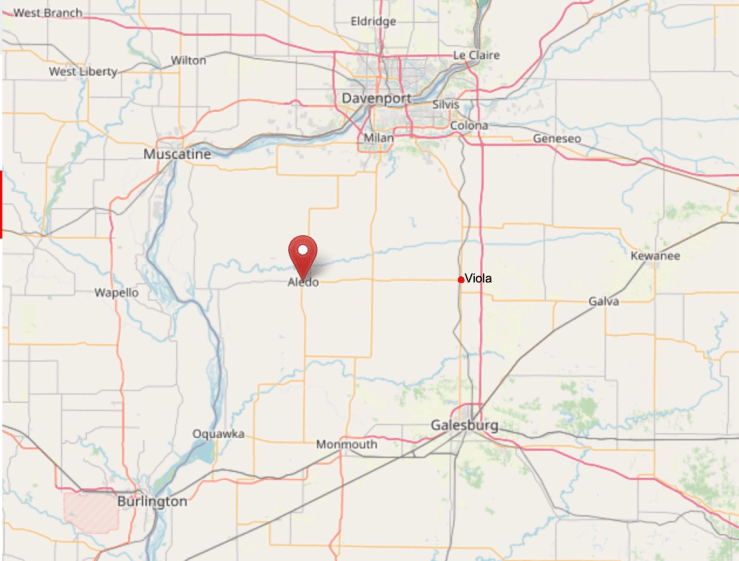
We moved from the farm, near Viola, Illinois, to Galva, Illinois, 30 miles to the east. There I started school in 1958. 

By the spring of the next year, we moved back to the Viola area, near Aledo, Illinois. I finished first grade here, attended all of second grade, but before Christmas of the third grade, we moved again, this time 44 miles west to Burlington, Iowa. I was disappointed because I had a part in the upcoming Christmas play.

I remember we spent Christmas in Burlington, but we moved again shortly after, this time 72 miles northeast to Rock Island, Illinois.

We didn’t stay long in Rock Island, either, and by spring we moved again. Our move this time took us back to my mother‘s childhood home in the small village of Millersburg, Illinois, 7 miles northwest of Aledo. 

There I would live for more than 40 years.

If you wonder why I mention the distances between towns, it is to show that we were never far from Aledo, where I was born in Mercer County Hospital in 1952 — the same hospital where my own children would be born years later. We never strayed far from our roots or our families.

My parents are gone now, so I can’t ask them why we moved so often during those three years. With the moves came job changes for Dad.

Looking back, I understand more than I did then. Those were hard years in the Midwest. Jobs weren’t always steady, and people took work wherever they could find it.

But as a child, I didn’t see any of that.

Both Mom and Dad were very hard workers — and my dad always had a job. If one ended, another one soon followed. We never went without anything. If things were tough for them, they never let us feel it.

All I knew was that we kept moving…

and somehow, we were never very far from home.

Mom, Meet Butch!

One afternoon when I was five, my mother put me down for an afternoon nap and decided to join me.

We were both sleeping soundly when we heard those words:

“Mom, meet Butch!”

We didn’t know anyone named Butch.

Mom opened her eyes.

She was face to face with an owl.

Butch the screech owl. And my brother was holding him.

Mom wasn’t amused.

It was well-known in our family that she didn’t like birds — at least not in her face. Or in her house. Or anywhere near her. Or near us kids.

She didn’t mind them from a distance, but she said they were dirty and carried mites. I wasn’t sure what mites were, but I got the idea they were some kind of crawly bug. Turns out I was right.

I don’t remember actually seeing the bird myself. I always took my glasses off when I was sleeping so I wouldn’t break them.

My brother wasn’t in the room much longer than it took to say those few words before Mom sent him scrambling back to the barn to put the owl back where he found it — cautioning him never to do that again.

Loudly.

Butch must have been a juvenile or Monty likely couldn’t have caught him. It never occurred to me to ask.

I do know Monty never brought a bird in the house again — or any other stray animal.

Sometimes I wonder if his ears were still ringing when he got back to the barn.

Bluebells in Spring

Bluebells — one of my favorite signs of spring — usually arrived sometime in April, along with gentle breezes and a general thawing of the land.

I lived just three blocks from school, so I walked there and back each day. There was a patch of bluebells I passed twice daily. They belonged to Mrs. Joseph — an elderly neighbor — but she said she didn’t mind if I picked a few.

I was careful not to take too many, so we both could enjoy watching them grow. Mostly, I stopped to smell them — once or twice every day for as long as they bloomed — but sometimes I gathered a small bouquet for Mom. They smelled so good.

A friend showed me how to pluck a blossom from the stem, place the stem end in my mouth, and draw out what I can only assume was nectar. What a sweet surprise.

One year, I made May baskets from construction paper and filled them with small bouquets of bluebells. I left one for Mrs. Joseph, one for Mom’s best friend Marion who lived next door, and one for Mom — and felt very grown up doing it.

There were other flowers in the neighborhood, of course — many in our own yard, as Dad was an avid gardener — but nothing was ever quite so sweet as those first bluebells in spring.

The Little Red Schoolhouse

Two years after we left the farm — in the spring of my third-grade year — we moved back to Mom’s childhood home in the little village of Millersburg, where so much of our family history already lived. 

It had been a tumultuous year for me. We moved often, and I was about to enter my fourth school in as many months — the fifth since starting first grade.

The new school — the little red schoolhouse that I became so fond of — was just two blocks from home. I would be able to walk or ride my bike back and forth.

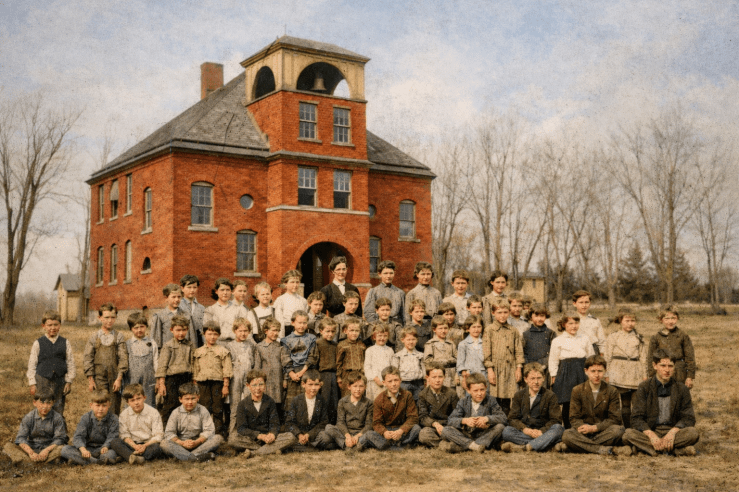
Color rendering of the Millersburg School re-created from a historic newspaper photo.

The school itself — and many of the kids who lived there — were already familiar to me. My Aunt Evelyn — Mom’s sister — lived across the street. When I visited, she often put me in touch with the neighborhood kids, so I already had playmates when we moved there.

The school was made of red brick. It was two stories tall with a bell tower on top, though the bell had been removed before I ever walked through its doors. 

There were only two classrooms — one for grades one through three and one for grades four through six. Both classrooms were on the ground floor. 

Each classroom had only one teacher. Miss Garner was mine. The teacher for the bigger kids was Mrs. Brayton. 

Upstairs was a large room where we all ate lunch and had our music lessons. We did other things there, too, like school Christmas celebrations and sometimes a class play. 

Next to it was the kitchen and the tiny library. Sometimes when I went upstairs to get a library book, I’d stop in next door to say hello to Mrs. Archer, the cook. 

When that Monday came, and Mom brought me to school for the first time, I wasn’t nervous like I was at those other schools. I knew the streets. I knew the kids. It felt like home. 

You’ve Got Mail!

When I was a little girl, my paternal grandmother used to send me things in the mail.

Sometimes, she tucked a piece of chewing gum into a letter that she wrote to my mom.

Several times, she sent me handkerchiefs that she crocheted pretty edgings on. I still have all eight of them.

It was always something flat that would fit neatly into an envelope so it would go through the mail for the standard price of a three-cent postage stamp. (I can still remember the displeasure my mother voiced when the price went up to four cents!)

It doesn’t seem like much by today’s standards to get a piece of gum in the mail. But at five years old, receiving an unexpected treat in the mailbox meant my Grandma was thinking of me.

Now, as an adult — and someone who made a career out of being a fiber artist — I can fully appreciate the time and care it took to crochet the edgings on those handkerchiefs and to knit the many pairs of slippers she made for me one Christmas long ago.