Waiting For the Bus in a Snow Cave

High winds, bitter cold, and swirling snow greeted us that morning as we stepped out the back door and began the walk to the bus stop at the end of our long driveway.

It was clear the walk was going to be rough. The high winds made it hard to keep our footing. 

We could tell there was a lot of snow in the driveway from the house. But our house and Nellie’s were side by side, so it wasn’t until we rounded her house that we got the full effect of it. 

The driveway was bordered on either side by wire farm fencing. It was full of snow to the tops of the fence posts, captured there by the fences themselves. 

The snow depth was almost as high as I was tall at eight years old.

In sharp contrast, the fields on either side of  the lane were windswept. 

To get to the bus stop, we had to climb up on top of the snow which, thankfully, had an icy crust strong enough to support us without breaking through.  

We could hear the wind as it skittered snow in waves across the frozen fields and the empty ribbon of highway. 

We were FREEZING by the time we got to the bus stop, the wind in our faces all the way, tiny stinging projectiles of snow assaulting every bit of our exposed skin. 

That’s when we noticed the storm had formed a snow cave in the ditch by the highway. 

The cave was big enough for us to fit inside if we crouched down. 

We ducked inside it and realized that it blocked most of the wind. It didn’t make it any warmer, but it was a relief to get out of the wind. 

Monty was a foot taller than me. He was able to see over the  tops of the drifts, so he positioned himself by the mouth of the cave so he could pop his head out occasionally and see if the bus was coming. 

Missing the bus meant missing a day of school. And neither of us wanted to try to explain that to Mom. 

After waiting about 15 minutes, the bus finally came. 

I have sometimes wondered what the bus driver thought when he saw two children suddenly pop up out of the ditch as he approached. He wouldn’t have been able to see the snow cave because the opening was facing away from the road. 

We scrambled onto the bus and were relieved to finally be inside where it was warm and out of the weather.  

On returning from school that afternoon, the wind had calmed down some, but we still had that long walk home. 

This time, we thought it might be easier walking through the field, so we jumped over the fence and walked home through the field. 

Since there was no gate on the side of the field where it bordered our house, we had to climb the wire fence when we got home. That wasn’t easy to do with frozen hands and bulky snow boots. 

The drive remained blocked for several days, so we had to repeat that walk to and from the bus daily. 

It was hard for Dad, too. Since the driveway was blocked, he had to park the car by the highway and walk home. It might have been harder for him, though, because he had to walk to the car and home again in the dark.

After Mr. Parkinson, the farmer who farmed the ground for Nellie, dug his own long drive out, he finally was able to clear our driveway. 

Many years have passed since then, and I have lived through a lot of harsh Illinois winters. But I have never seen another driveway fill completely to the tops of the fence posts or form a crust so hard we could walk on it without breaking through.

And I have certainly never waited for a school bus in a snow cave again.

Watching Mom Crochet

Mom was sitting on the end of our black sectional sofa, the one with silver threads running through it, crocheting a doily. It wasn’t the first time I had seen her crochet—but it was the first time I really paid attention.

I sat down beside her to watch.

She was working with dark pink and forest green crochet thread, two of her favorite colors.

I wanted to understand how she formed the stitches that made the doily grow. Her quick hand movements—and the steady progress of the piece—fascinated me.

I watched her for a long time that day. And after that, whenever she sat down to crochet, I often sat beside her to watch.

I couldn’t figure out how she did it, but I wanted to learn.

She didn’t think my seven-year-old hands would be able to manage a tiny steel hook and thread, so she gave me a blue plastic crochet hook and a ball of bright pink yarn.

She taught me how to make a chain stitch. I used up most of that yarn making one very long chain.

She tried to show me how to turn those chains into something more, but I lost interest before I had much success. It would be years before I picked it up again.

Later, when I was about eleven, a friend taught me to knit in garter stitch. I made a lot of knitted headbands that year.

In my late teens, I picked knitting up again for a while—but I was never completely comfortable working with two needles.

It felt awkward.

That’s when I turned back to crochet.

I taught myself the basic stitches from a book and quickly realized that working with a single hook felt far more natural.

As I became more invested, I learned advanced techniques and began making hats, baby blankets, purses, mittens—even rugs.

Before long, I realized I could look at a finished piece and write a pattern from it.

That led to designing my own patterns.

Eventually, I became confident enough to submit them for publication.

The first few were turned down, but I was determined. Each rejection taught me something. I studied my work, paid attention to what publishers were accepting, and adjusted.

Before long, more and more of what I submitted was accepted.

That was the beginning of what became a decades-long career in crochet design.

Rose Garden, a doily I designed many years later. Mom would have loved this one.

In 2004, that path led me to accept an editorial position with a Midwest craft publishing company, where I worked for several years before retiring.

I have long since lost track of that first ball of bright pink yarn—but I still have the blue plastic crochet hook Mom gave me.

Over the years, I’ve collected many hooks—favorites I reach for again and again—but none of them compare to that simple blue plastic one.

That one holds the memories.

Memories of sitting beside Mom as she worked with a tiny steel hook, creating what felt like magic out of thin air.

I’ve often told people that Mom taught me to crochet, because she was the first to put a hook in my hands.

She always gently corrected me, saying it was the other way around—that I taught her by passing along what I had learned.

Either way, she was my inspiration in crochet—and in so many other things in life.

And to think… it all started with watching Mom crochet.

Dancing With Dad

Mom and Dad met at a dance in the late 1940s, after World War II.

They loved dancing. On Saturday nights, they sometimes went out with friends. Their favorite place was the Coliseum in Davenport, Iowa—later renamed the Col Ballroom.

They especially loved waltzes and had a number of records they played at home.

We were lucky to have older cousins who could babysit Monty and me.

Eventually, they stopped going to the Col when the music shifted from Big Band to pop.

But their love of dancing never changed.

Some evenings, they would put on records and dance right there in the living room. Waltzes were always their favorite.

One evening, they set the record player on a table in the little dinette area tucked into one corner of the room.

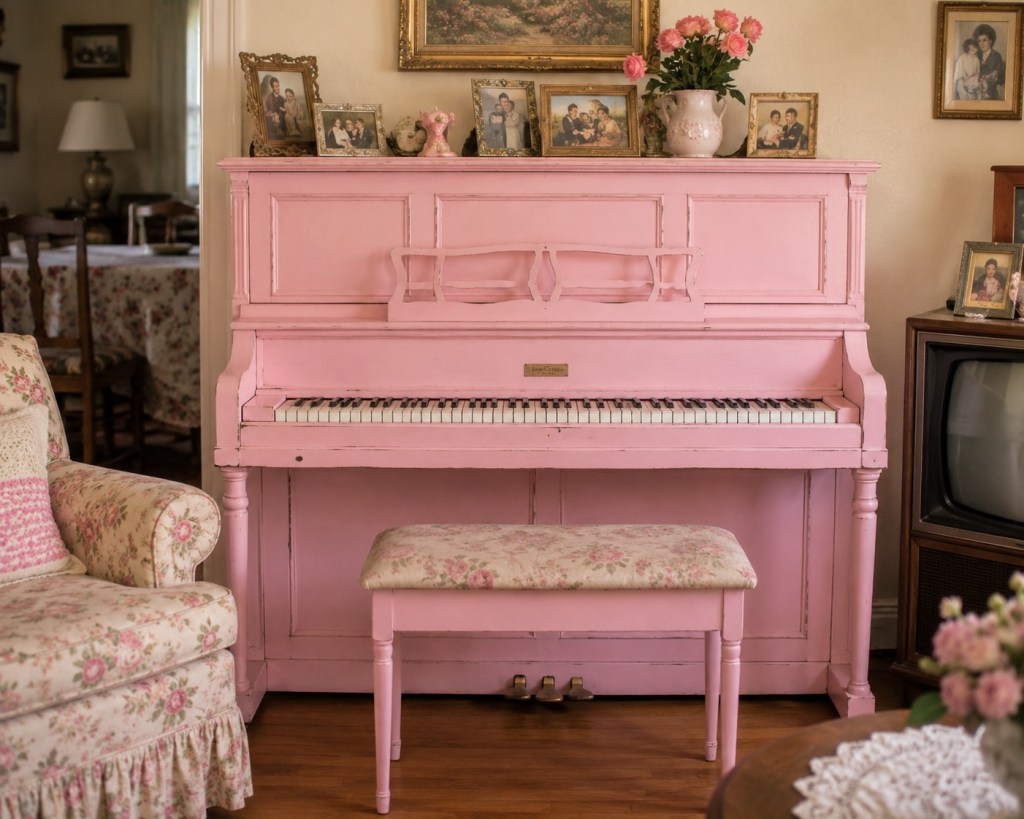
I can still see it—the black sectional couch with silver threads running through it, the arched doorways of our mid-century modern home, the kitchen at the far end.

I wanted to dance too, but I didn’t know how.

Then, to my delight, Dad asked me to dance.

He told me to step up onto his feet—we were both in our socks. Mom put The Blue Danube on the record player, and suddenly we were waltzing around the room.

I don’t know how he made it look so effortless—especially with me standing on his feet—but he did.

The next dance was for Mom.

I sat quietly on the couch, watching them, listening to the music, taking it all in.

It’s an evening I’ve never forgotten.

The Pony and the Pig Wallow

There are some lessons you only learn once—preferably not in a pig wallow. 

I was seven when I learned that if a pony puts his head down, the rider keeps going. It was my first lesson in physics. 

One minute I was riding bareback, with nothing to hang onto but the pony’s mane. The next, I was in the pig wallow.

I did not see it coming. One moment I was upright and feeling quite capable. The next, I was flat on my back in something warm, muddy, and unmistakably pig-related.

Pig-yuck was dripping from the top of my head to my toes.

I wasn’t hurt, but I was—stunned. I had to take my glasses off so I could see, because they were covered in that same pig-yuck. 

I wasn’t far from the house, so I climbed over the fence and walked up to the back door. 

I yelled for Mom. I knew better than to walk into the house like that.

Mom came to the door. The look on her face was one of pure horror. She didn’t say much besides “What did you do?”—sort of loudly.

I tried to explain, but by then she had turned the garden hose on me…

She hosed me down starting at the top of my head, then stripped my clothes off, and hosed me down again. 

Then she wrapped a bath towel around me and carried me to the bathtub so I wouldn’t get the floor all dirty. 

By this age, I was old enough to take my own bath, but not that day. She gave me one. Then she drained the bathtub and gave me another. 

That was the last time I rode the neighbor’s pony without permission. Physics and pig-yuck are persuasive teachers. 

My Teacher Saved My Life

I was seven years old when I asked my teacher about the mole on her arm.

She had dark hair and fair skin, like me. I had freckles—lots of them—and I was curious. Children are not subtle. If we notice something, we ask about it.

Instead of brushing off my question, she answered gently.

She told me that because I had so many freckles, I should keep an eye on them. She pointed to one on my upper arm in particular and said I should watch it in case it ever wanted to be something else.

She didn’t frighten me.

She didn’t lecture me.

She simply planted a seed of awareness.

And I listened.

For two days, I tried to remember her name.

Then I said her first name out loud—Mary Jane—and “Clawson” came back immediately. I have always liked her name.

Thirty years later, I remembered.

I was thirty-eight years old when that freckle on my upper arm began to change. It developed tiny flecks of blue that hadn’t been there before. It didn’t look dramatic. It didn’t hurt. But it didn’t look the same anymore.

Because of what she had told me when I was seven, I had watched it over the years. Not obsessively. Just attentively.

Around that same time, my youngest son didn’t want to go to school one morning. He said he felt sick. I wasn’t entirely sure I believed him, but I took him to the doctor that day.

By the time we were in the exam room, he seemed fine. The doctor couldn’t find anything wrong. Since we were already there, I asked him to look at the freckle on my arm.

He examined it once—just once—and scheduled me for surgery.

It was malignant melanoma.

Scott was eight at the time. The other kids were teenagers, but they still needed their mother.

So I did what needed to be done.

The surgeon removed the melanoma along with a generous margin of surrounding tissue. I carry the scar on my upper left arm to this day, and another on my leg from the skin graft that closed the wound.

I was seven when Mary Jane Clawson told me to watch that freckle.

I was thirty-eight when I remembered.

She never knew what her quiet advice would mean to me.

But I did.

And I am still here.

The Train Tracks In Our Front Yard

Just beyond the boundary of our front yard, a railroad track ran east toward Viola and west toward Aledo. We were in between the two, but closer to Aledo.

Dad and Monty always kept our yard neatly mowed. But the strip along the tracks — the part that belonged to the railroad — was left alone. There weren’t many weeds, just tall grass.

Monty and I liked to play in it. We would mash the grass down with our feet, and those flattened spots became forts or little houses.

We spent many summer afternoons there, in the sunshine and fresh air, pretending.

Sometimes a train would come by. They didn’t go very fast, and they weren’t very long. Most were only eight or ten cars — sometimes less, sometimes more — and always with a caboose.

We knew to stay back in the yard and away from the tracks when the trains passed.

Later, I learned that it was a spur line, and the trains were delivering freight to local businesses.

Sometimes the engineer had his window open, with his arm resting on the sill. We waved, and they often waved back.

Sometimes, a handcar would come along, with two men pumping the handles to make it go.

We always thought those were funny to watch.

Listening to the Little Kids Read

When I was in second grade, Mrs. Clawson asked me to help the younger children learn to read.

She gave me a copy of the reader they were using and told me which story they were working on. Since it was the same reader I had used the year before, I already knew the stories.

The desks were lined up in neat rows, all facing the blackboard.

I would pull a little chair up beside a student’s desk and listen while they read out loud. When a child came to a word they didn’t know, I encouraged them to sound it out. If that didn’t help, I would tell them the word.

There was something satisfying, even at the age of seven, about being able to help.

I really enjoyed it — and I was proud that Mrs. Clawson trusted me to do it.

Of course, I had my own work to do, but if I finished early and she needed someone to listen to the first graders read, she would ask if I would like to help. I always did.

The next year, when I started third grade, I moved to a different classroom. Even then, there were times when Mrs. Clawson asked my new teacher, Miss Nesbitt, if I could come back and listen to her students read.

I didn’t know it at the time, but I suppose that was my first experience as a tutor.

Mom vs the School Superintendent

The superintendent said, “No.”

Mom said, “Want to bet?”

In the 1950s, our school district, like so many others, had a strict dress code. Girls were required to wear dresses to school. No exceptions.

I liked wearing dresses, so that was fine — at least until winter came.

The school bus would not drive down our long driveway, so Monty and I had to walk out to the highway and wait for it to pick us up.

We had to make sure we got there first. If we missed the bus, we missed a day of school. We had only one car, and Dad took it to work.

Sometimes the wait stretched to fifteen or twenty minutes if the roads were icy or snowy and the bus was delayed.

In the worst part of winter, there was often severe cold and deep snow. One time, the wind was so fierce that Monty and I ducked into a snow cave that had formed along the drift just to get out of the wind.

Another time, the snow completely filled our driveway to the tops of the fence posts. Then a thick crust formed on top, and we had to walk across it to reach the highway.

I had several pairs of corduroy slacks, so Mom started putting them on me under my dress, with instructions to take them off and leave them with my coat and boots when I got to school.

The first day I wore them, Mrs. Clawson quietly and gently told me it was against the rules and that I shouldn’t do it again.

I told Mom when I got home that afternoon.

She didn’t say much to me about it, but she called the district superintendent. She explained that I would continue wearing slacks to school, but that I would remove them once I arrived in order to comply with school rules.

He didn’t like that at all.

He told her that once I stepped onto the school bus, school rules applied — and that I had to follow them.

Mom didn’t think so.

She explained about our walk to the highway, the long waits in the cold, and the winter weather. Then she told him that I would continue wearing slacks to school — whether he liked it or not.

I’m sure he didn’t like it.

But no one ever told me I couldn’t wear them again.

I continued wearing them until the weather warmed up, and I kept doing so as long as we lived there.

Mom didn’t brook any nonsense when it came to her kids. She didn’t start fights, but she always finished them.

The Cat at the Door

Our school scheduled a PTA meeting one cold and snowy winter night. My whole family would be attending, since Monty and I were now in the same school.

When we moved to Aledo, Monty and I began attending Frew School, a three-room country school not far from our house. In those days, before school districts consolidated and country schools disappeared, it was common to have several small country schools scattered throughout a district for farm families.

As an agricultural community, there were a lot of farm kids.

Mom helped us kids get ready while she and Dad were doing the same. They were both all dressed up — Dad in a sport coat and dress slacks, and Mom in a dress and high heels. Us kids wore clean school clothes.

Once Mom was satisfied that we were scrubbed, properly dressed, and didn’t have a hair out of place, it was time to leave.

There was about a foot of snow on the ground that night. Dad had scooped a path to the car earlier, since we didn’t have a garage.

He turned the outside light on as he went out ahead of us to warm up the car. Monty and I followed a few minutes later to give it time to warm.

The three of us were sitting in the car waiting for Mom to come out. When she did, she leaned over to pet the cat who was eating out of its bowl.

The “cat” looked up and hissed.

It wasn’t a cat. It was a possum.

It turned to look at her — and that’s when she realized two beady eyes were staring at her, attached to a face with a long pointed nose and rows of sharp teeth.

POSSUM! And the cat was nowhere to be found.

She went flying across the yard — in high heels — completely ignoring the path Dad had so thoughtfully dug, and made a new path of her own to the car.

By this time, Dad, Monty, and I were laughing, watching her mad rush to the car. Because the snow was deep and had a light crust on top, she had to lift her feet high with every step. It was a sight to see, for sure.

Breathless, she opened the car door and scrambled in, slamming it hard behind her.

We were still laughing. I’m not sure she appreciated it. She didn’t say much about it other than to tell us what happened. We could tell it really scared her.

Over the years, we brought this memory up occasionally. Time softened her sense of humor, and she could relate the story with a twinkle in her eye. She forgave us for laughing at her.

Funny thing is — we didn’t even own a cat. It belonged to the farm.

Frew School

I remember the day Mom registered me for school clearly.

I stood behind her while she talked with my teacher, Mrs. Clawson. After Mom left, Mrs. Clawson showed me into the classroom and gave me an empty desk.

The school had three classrooms and six grades, so there were two grades in each one. Mrs. Clawson taught first and second grade. Miss Nesbitt taught third and fourth grades. Mrs. Dahl taught fifth and sixth grades. Each classroom had its own area for us to hang our coats and store our boots.

The classrooms were all lined up in a row on the east side of the building. My classroom was the first one inside the front door, then the middle grades, and finally the upper grades.

The other side of the building housed the bathrooms, the lunchroom, and the kitchen.

Sometimes the tables and chairs would be folded up, giving us an open space for activities. I especially remember the times when the record player came out. Mrs. Johnston visited once a week to teach music, and I think that may have been when we learned the bunny hop. I can still picture us hopping around the room in a circle with our hands on each other’s shoulders as the music played.

I settled quickly into the new school. I liked my teacher and the other kids. There were swings on the playground, and I especially liked playing hopscotch on the cement entrance to the school with the other girls during recess.

Dad found a new job right away. He said he was a Fuller Brush Man. I didn’t know what he did at first. He said he went door-to-door selling things. He showed me the case he carried with him and all the things inside it. Some of them were pretty interesting.

We lived down a long driveway. Across the highway was another long driveway with a farm at the end. That is where my friend JoAnn lived.

We stayed there longer than we had in Galva, and before long it felt like home.