Ice Cream Cones and Car Rides

Some lazy summer evenings, after supper and the dishes were done, we’d head to the Tastee Freeze for ice cream before taking a slow drive through town.

It was nothing special, but it was a chance to get out of the house and do something different. 

We waved to people we knew, and slowly drove the familiar streets.   

We saw children playing in the yard, people watering flowers, and lights coming on in windows.

We weren’t spying on anyone. We were simply enjoying the feeling of a town settling in for the evening. 

There was something comforting about seeing porch lights come on and families gathered inside their homes. Even then, I think I was quietly wondering what their stories were.

We didn’t know everyone, of course, in a community of over three thousand people. But we had been born and raised in this small town, and so had our children. It was our town, and these were our people, whether we knew them all or not.

I have always been a listener, an observer. I had no way of knowing back then, but all of these little moments were quietly tucked into the back of my mind, and now they seem to be clamoring to be told. 

Our lives were pretty ordinary. We worked hard, took care of our family, and built a life that made us happy. 

At the time, those evenings were pleasant but they didn’t seem to be more than that. They were simply a way for our family to spend an evening together.

Looking back, I realize they were far more than that. 

They gave me a sense of belonging—to my family and to my community. I didn’t think of it in terms of contentment then, but I know now that’s exactly what it was. I was content, and I was home. 

Thirty Years and a Lunch Bucket

Dad walked into the East Moline Works of International Harvester one Monday morning carrying his black lunch bucket with the silver latches—the kind with the domed lid that held his Thermos of coffee in the top. 

He didn’t work there. His last job had ended, and he was looking for a new one. He  told Mom he would be back when he found one.

International Harvester was a big employer in our area. Getting a job there could easily become the start of a career. 

Dad walked into the plant manager’s office. When it was his turn to be called inside, the plant manager offered him a seat and asked him why he was there. 

“I’m looking for a job,” Dad said. “I’ll do any job, no matter what it is. I’ll sweep floors if that is all you have.”

The manager listened, then shook his head and said, “I’m sorry, but I don’t have anything for you. We aren’t hiring.” 

Dad stood and thanked him, then left the office—but he didn’t leave the plant. He took a seat in a chair just outside the manager’s office. 

When the day shift ended at 3:30 pm, Dad left to find something to eat. At night, he slept in the car. He returned at 7 am the next morning when the day shift began, lunch bucket in hand.

He continued this routine for most of the week.

Dad said the plant manager began giving him odd looks as he went in and out of his office. Later that week, he stopped and asked Dad, “You’re still here?”

“Yes, and I’m going to be here until you give me a job.”

Dad said the manager shook his head and walked away. 

The next day, the manager approached him with a broom in his hand. 

He handed it to Dad and simply said, “Start sweeping.”

Before the day was over, Dad had his ID badge and was an official employee. 

Dad swept floors for a few days but was soon promoted to machinist, a job he held for over twenty years. He fed sheets of metal into a machine, making parts for combines and other equipment. 

As he neared retirement age, Dad developed some health issues, so they gave him a job as a fork truck driver. 

Eventually, Mom and Dad relocated to East Moline so Dad wouldn’t have the nearly 75 mile round trip to and from work every day. They were fortunate to locate a home just outside the entrance to the plant. 

When I was in my late thirties, International Harvester hosted an open house, inviting the families of their employees to attend. 

Dad said they cleaned for days to get the plant ready.

Our whole family attended. Dad showed us around and explained what his job was. It was amazing how many processes those sheets of steel went through before they became finished pieces of farm machinery.

It made Dad’s stories about the different jobs he performed in the space of a day easier to understand. 

I was impressed. The machinery Dad was helping to build was so much bigger and more complex than the simple machinery he had back on the farm. 

The open house answered questions I had wondered about for years. 

“What was it like where Dad worked?” 

“What did he do there?”

Of course, he had shared what it was like, but that isn’t the same as seeing it for myself.

The next day, I wrote a letter to the plant manager thanking him for allowing me to see what I had always wondered about as a child.

He didn’t answer me, but I didn’t expect him to. 

However, I was surprised the next time I saw Dad. He grinned, and handed me a copy of the company newsletter. 

They had printed my letter verbatim thanking them for the open house and telling them about the questions it had put to rest for me! 

I was so surprised! And it was obvious that Dad was proud something I wrote was chosen for the company newsletter.

Dad retired at age sixty-six, after a career that spanned thirty years. 

The lunch bucket was retired, too. 

A short time later, he stopped by to visit with his foreman. They shared a good laugh when his foreman told him they had given his job to two younger men—because one couldn’t keep up.

I can picture him laughing with a twinkle in his eye when his foreman told him that, because it happened every time he told the story afterward. 

That was my Dad. He was an exceptionally hard worker, always focused on the job at hand, and doing it to the very best of his ability. 

When I was growing up, I didn’t think too much about why he worked, other than the fact that it was just something that fathers did. 

Now I realize he did it all for us—to give our family a nice home, plenty to eat, and the kind of loving home life we enjoyed growing up.

I know it couldn’t have been easy, but he did it anyway. For us. For thirty years. 

Because that is just who he was. 

Who Am I? I Was Her All Along.

I began writing this blog to leave behind family stories for my children and grandchildren.

My writing unfolded chronologically, weaving my stories together with memories of my family and the stories they told me. 

In considering the header for the blog, I wanted one that honored those stories and my voice.

I had a vision for a roll-top desk, but that alone wasn’t quite right. Something was missing. 

Then I came across a nature scene.

It made me stop and take a quick intake of breath. 

And in that moment, something shifted.

This is who I am.

The little girl who grew up on a farm.

The little girl who always had a passion for words from a tender age. 

The little girl who discovered a desire to write in grade school, but didn’t know how to get started. 

Over the years, I’ve tried to answer that question—who am I?—more than once. The answers were usually measured by roles.

  • daughter
  • friend
  • student
  • wife
  • mother
  • crochet designer
  • grandmother
  • editor
  • caretaker
  • widow
  • writer

But none of those, standing alone, ever told the whole story.

They were all true—but they were not the beginning.

The beginning was the farm.

Now I understand why.

It isn’t the place I’m holding onto.

It’s her.

That little girl, living on a farm with her mom and dad and her brother.

She isn’t just part of my story.

She is me.

Grown now.

Shaped by years of living—by love, marriage, children, profound loss, and learning to live again.

And now, by writing.

But still her.

Her story—my story—isn’t over.

There are many tales left to tell. 

Watching Mom Crochet

Mom was sitting on the end of our black sectional sofa, the one with silver threads running through it, crocheting a doily. It wasn’t the first time I had seen her crochet—but it was the first time I really paid attention.

I sat down beside her to watch.

She was working with dark pink and forest green crochet thread, two of her favorite colors.

I wanted to understand how she formed the stitches that made the doily grow. Her quick hand movements—and the steady progress of the piece—fascinated me.

I watched her for a long time that day. And after that, whenever she sat down to crochet, I often sat beside her to watch.

I couldn’t figure out how she did it, but I wanted to learn.

She didn’t think my seven-year-old hands would be able to manage a tiny steel hook and thread, so she gave me a blue plastic crochet hook and a ball of bright pink yarn.

She taught me how to make a chain stitch. I used up most of that yarn making one very long chain.

She tried to show me how to turn those chains into something more, but I lost interest before I had much success. It would be years before I picked it up again.

Later, when I was about eleven, a friend taught me to knit in garter stitch. I made a lot of knitted headbands that year.

In my late teens, I picked knitting up again for a while—but I was never completely comfortable working with two needles.

It felt awkward.

That’s when I turned back to crochet.

I taught myself the basic stitches from a book and quickly realized that working with a single hook felt far more natural.

As I became more invested, I learned advanced techniques and began making hats, baby blankets, purses, mittens—even rugs.

Before long, I realized I could look at a finished piece and write a pattern from it.

That led to designing my own patterns.

Eventually, I became confident enough to submit them for publication.

The first few were turned down, but I was determined. Each rejection taught me something. I studied my work, paid attention to what publishers were accepting, and adjusted.

Before long, more and more of what I submitted was accepted.

That was the beginning of what became a decades-long career in crochet design.

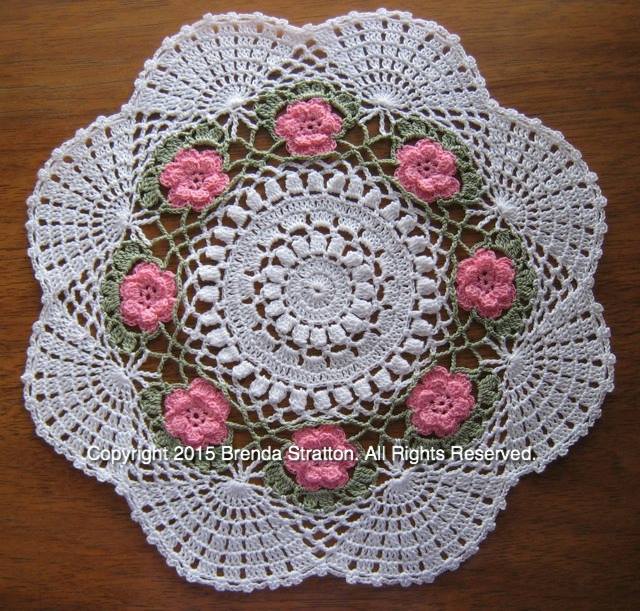
Rose Garden, a doily I designed many years later. Mom would have loved this one.

In 2004, that path led me to accept an editorial position with a Midwest craft publishing company, where I worked for several years before retiring.

I have long since lost track of that first ball of bright pink yarn—but I still have the blue plastic crochet hook Mom gave me.

Over the years, I’ve collected many hooks—favorites I reach for again and again—but none of them compare to that simple blue plastic one.

That one holds the memories.

Memories of sitting beside Mom as she worked with a tiny steel hook, creating what felt like magic out of thin air.

I’ve often told people that Mom taught me to crochet, because she was the first to put a hook in my hands.

She always gently corrected me, saying it was the other way around—that I taught her by passing along what I had learned.

Either way, she was my inspiration in crochet—and in so many other things in life.

And to think… it all started with watching Mom crochet.

Transitions

I didn’t expect much from today when I woke up this morning. The only thing on my agenda was to catch up on some laundry.

My day starts off like usual… feed the dog, feed myself, dispense meds, and get started.

After Gracie, my fifteen-year-old Shih Tzu, and I eat breakfast, I load the dishwasher and tackle the laundry.

I have way too many clothes—a result of gaining control of my diabetes and losing weight. I now have two sizes of clothes: what I wore before, and what I can wear now.

I am sorting through the larger clothes so I can pass them along, keeping a few oversized T-shirts because they’re comfortable. They also make great work shirts.

We’re in that in-between stretch where the seasons can’t quite make up their minds, so I’m trying to put my winter clothes away. That can get tricky here in the Midwest. Just when it feels like spring has settled in, winter rushes back and says, “Not so fast.”

I am packing the clothes I can no longer wear so I can pass them along. The winter clothes I still wear will go into storage—soon, once I’m sure Mother Nature is finished playing seasonal roulette with the weather.

But it’s not just about the clothes. It’s the space they take up—and what they represent.

The same is true for so many other things in my house.

I’m transitioning my office from designer Brenda to writer Brenda.

There are still too many pots and pans and small appliances in my kitchen—more than I need now. My family is smaller, and I don’t cook the way I used to when Carl and all four children were here.

I don’t need all of this anymore. I’m still figuring out what stays—and what it means to let the rest go.

Depression, Grief, and Healing

This piece discusses personal experiences with depression and grief.

Depression didn’t arrive all at once for me.

By the time I recognized it, it was already there.

It’s something I have struggled with at certain times in my life, which always surprised me. I have always thought of myself as a happy, easygoing person.

The hardest times came during periods when my role in life was changing.

The first time happened in my early forties. My children were growing up and no longer needed me in the same way they once had. I had been a mother for over twenty years, and that had become a large part of my identity.

This wasn’t about anything they did—it was simply a change I wasn’t prepared for. I didn’t yet know how to redefine who I was beyond that role.

It came on quietly. So quietly that I didn’t even realize what was happening until I was already deep in it.

I hurt—not physically, but somewhere deeper. I withdrew from people and from things I had once enjoyed. And when it became too much, I slept. When I was sleeping, I didn’t hurt.

Eventually, I realized something was deeply wrong. I went to my doctor and got the help I needed.

It didn’t get better overnight, but with time—and with the patience and support of my family—I found my way through it.

I learned a great deal about myself during that time. I thought I had learned enough to keep it from happening again.

For nearly thirty years, life moved along well.

Until it didn’t.

My husband, Carl, whom I had been married to for more than fifty years, became ill and passed away.

My world changed in an instant.

I believed I was grieving in a normal way, whatever that means. But over time, something else settled in.

This time, it wasn’t the same as before.

It wasn’t the kind of depression I had known. It felt different—quieter, heavier, and harder to recognize.

I didn’t recognize it. I thought I was simply moving through loss.

But looking back, I can see that I was just marking time.

I lost interest in so many things. I didn’t want to go out or see people. I let hobbies go. I withdrew into my home.

My children brought me joy—as they always have—but beyond that, I wasn’t really living.

I even stopped taking care of my health. As someone with diabetes, that is a dangerous path.

It took something unexpected to shake me out of it. A situation that forced me to stop and take a hard look at my life.

Recognizing the apathy for what it truly was became the turning point.

That’s when I began to heal.

I took a serious look at my health and realized I needed to make changes if I wanted the rest of my life to be different.

I got my diabetes under control, and in the process, I lost forty pounds.

But healing didn’t stop there.

I have always been a writer at heart. As a student, I wrote stories, essays, and poetry. Later, writing became part of my work—as a crochet designer and as an editor.

In 2025, I began to explore writing in a different way. I had so many stories in my mind—from my parents, from my life—and I wanted to preserve them for my children and grandchildren.

As I began to write those stories down, something shifted.

I found healing.

I found purpose.

I was no longer just marking time.

My life began to feel meaningful again.

And in ways I didn’t expect, that sense of purpose continues to grow.

Moving from the Farm Into Town

In early summer of 1958, after school was out for Monty, we moved from our farm in Wanlock, just outside Viola, Illinois, to Galva — about 30 miles east — where my world expanded in ways I couldn’t yet begin to imagine. Life would never be quite the same. 

There were so many “firsts.” For the first time in my six years of life: 

– The wide open spaces of the farm were replaced by  houses that were built closer together with a state highway outside our front door that I was forbidden to cross. 

– We had indoor plumbing! I was fascinated by the bathtub, which Mom let me play in sometimes. That meant no more baths at the kitchen sink, and no more trips to the outhouse when it was raining or in the cold of winter. 

– I was finally old enough to start school that next fall.  I had been begging for this for a couple of years, and now my fondest wish was granted. It would impact my life in ways I could not have foreseen, and set me on a journey of learning that continues to this day. 

– I lost my best friend and constant companion —  Brownie, our farm dog. City ordinances said he had to be tied. He was clearly unhappy, so he went to live on another farm with new children to play with. 

– Monty and I had a little more freedom. The town was small, but it had a candy store in the center of town. We were occasionally allowed to walk there to spend our nickels and dimes. There was also a concrete wading pool nearby which was open to the public — but couldn’t have been more than a foot deep. I had to sit or lie down to get wet all over.

– I made new friends. Susie lived a short distance away. The Mohnen twins (both boys) lived across the street. The lady who lived opposite us on the other side of the state highway liked to hold me on her lap, but I could only go see her if Mom was with me. 

I missed the farm, but there were so many new experiences that I also enjoyed so I adjusted quickly. 

The move into town was only the beginning of a lifetime of learning and growth. 

I would never visit the farm again except for two or three times as an adult when we were in the area, a nod to the nostalgia of my childhood. But sadness in losing it never truly came, because it is deeply embedded in my memory and lives on in my stories. That is why I write them — to remember, and for them to live on in the lives of my children and grandchildren and all who come after. It is also to leave behind a small bit of history —  to tell what life was like on a northwestern Illinois farm in the 1950s.

When The Quiet Comes

When my family was young and life was busy and noisy, it did not prepare me for the quiet that came after.

As the years passed, life changed. The kids grew up and built lives of their own. They no longer needed me in the way they once had—and that is as it should be. They no longer depended on me for meals, schedules, or bedtime stories. Their lives expanded outward—as they should.

And suddenly, the house was quieter.

It was unsettling at first. My life had revolved around my children for so many years that I didn’t quite know what to do with the empty spaces that appeared when they left. The quiet felt heavy. It surprised me.

At first, I threw myself into work. As a crochet designer, I took on more projects, more deadlines, more responsibility. It helped—but only partially. I still felt the quiet waiting when the work was done.

Then Carl and I began talking about going back to school. Neither of us had ever gone to college. The idea started as a conversation, then became a plan. By the fall semester of 1986, we were enrolled.

Suddenly, there was no quiet at all. We balanced family, home, jobs, and school. It was the busiest season of our lives — and one of the most fulfilling. We were growing in new directions together.

But life has a way of shifting rhythms. Just when you think you understand its pattern, it changes again.

And in time, the quiet returned.

Only this time, I understood it differently.

The quiet was no longer something to fill or escape. It became space—room to think, to create, to remember, to become. It became the place where new parts of myself emerged. The place where stories surfaced. The place where writing began.

I’ve learned that every season has its sound.

And sometimes, the quiet is not an absence at all—but an invitation.

Stepping Into 2026, Gently

2025 was a year of awakening and transformation for me. As the world around us has changed outwardly, so have I changed inwardly in myriad ways. 

Life after great loss brought me to a threshold, where I had to choose between staying stuck and stepping forward. I chose to step forward. 

I learned a great deal in 2025—particularly about what I want in my life, and where I am going next. What surprised me most was not the clarity itself, but the quiet confidence that came with it. For the first time in a long while, I feel grounded enough to move forward without rushing, without bracing for impact, and without needing to prove anything to anyone.

I am stepping into 2026 more gently than I have stepped into years past. Not cautiously, but intentionally. I am no longer interested in rushing toward what comes next or measuring my life against some imagined timeline. I want room to breathe, to notice, and to enjoy the life that is unfolding in front of me. If there is a theme for this year, it is presence—showing up fully, without armor, and trusting that where I am is enough to begin.

This space will reflect that same intention. It will be a place for honest words, remembered moments, and stories told without urgency. A place where grief and joy are both allowed to sit at the table, and where nothing needs to be fixed before it can be shared. If you’ve found your way here, you are welcome to rest awhile. There is no agenda, no expectation—just room to be human, together.

As we enter 2026, I wish you peace, happiness, and everything you need to sustain you. 

Brenda