Ice Cream Cones and Car Rides

Some lazy summer evenings, after supper and the dishes were done, we’d head to the Tastee Freeze for ice cream before taking a slow drive through town.

It was nothing special, but it was a chance to get out of the house and do something different. 

We waved to people we knew, and slowly drove the familiar streets.   

We saw children playing in the yard, people watering flowers, and lights coming on in windows.

We weren’t spying on anyone. We were simply enjoying the feeling of a town settling in for the evening. 

There was something comforting about seeing porch lights come on and families gathered inside their homes. Even then, I think I was quietly wondering what their stories were.

We didn’t know everyone, of course, in a community of over three thousand people. But we had been born and raised in this small town, and so had our children. It was our town, and these were our people, whether we knew them all or not.

I have always been a listener, an observer. I had no way of knowing back then, but all of these little moments were quietly tucked into the back of my mind, and now they seem to be clamoring to be told. 

Our lives were pretty ordinary. We worked hard, took care of our family, and built a life that made us happy. 

At the time, those evenings were pleasant but they didn’t seem to be more than that. They were simply a way for our family to spend an evening together.

Looking back, I realize they were far more than that. 

They gave me a sense of belonging—to my family and to my community. I didn’t think of it in terms of contentment then, but I know now that’s exactly what it was. I was content, and I was home. 
Two Longs and a Short

Party lines were a fact in the 1950s, and many rural areas didn’t convert to private lines until much later — around 1990. 

We didn’t have phone numbers in those days. We had rings. Ours was two longs and a short. 

Whenever the phone rang, everyone in the household listened carefully to see if the call was for us. When the phone rang at our house, it also rang in every other house on the party line. 

Sometimes it was hard to tell who the call was for. If you were just coming in from outdoors or another part of the house, you might not hear the entire ring.

Mom taught me the difference between our ring and those of our neighbors. I appointed myself the household sentinel to announce to the house in general — and Mom in particular — if it was indeed two longs and a short. 

The polite thing to do when answering the phone was to pick the receiver up and listen carefully for a moment to see if anyone else was already talking, then hang up if the call wasn’t for you. 

Not everyone was polite enough to follow this protocol. Some people would stay on the line and listen, a practice often referred to as rubbering. The people the call was for could usually tell someone was listening in, but only had suspicions as to who it might be. 

I wasn’t allowed to use the phone in those days — yet somehow, that old black box still found its way into my childhood.

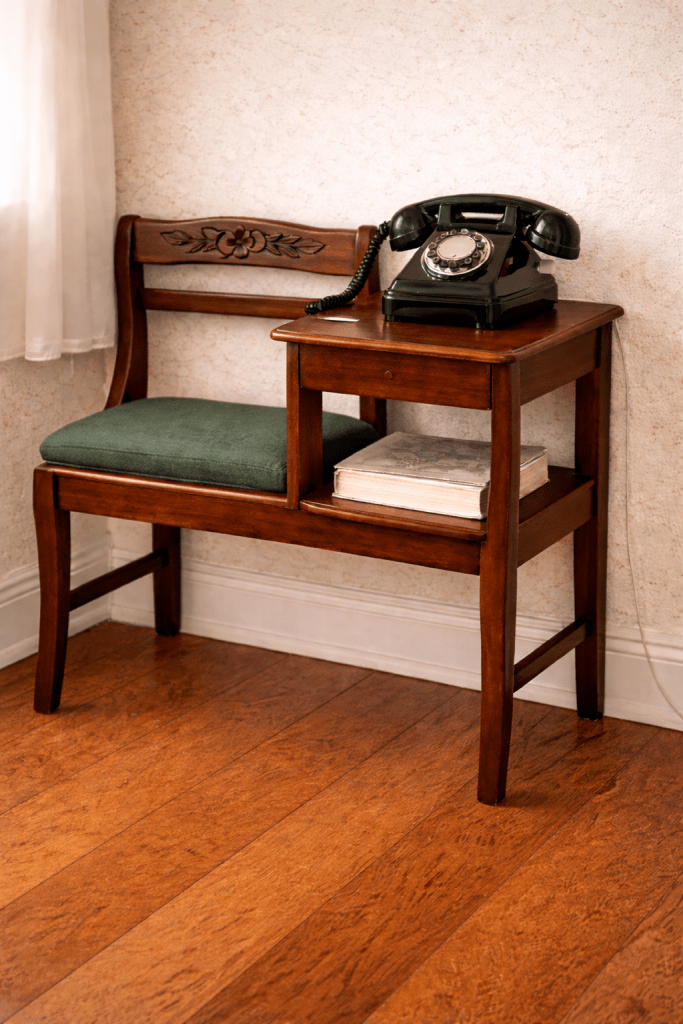
It was a heavy, black desk telephone — the kind that seemed as solid as a small piece of furniture. A sturdy black base anchored it in place, and the handset rested across the top in a simple, unpretentious cradle. In the center sat the familiar rotary dial, its round finger holes lined with numbers that circled back toward you as you released them.

There was nothing delicate about it. The phone felt permanent, rooted to its spot on the phone table, as if it had always been there and would always remain. The cord, still straight then, stretched toward the wall in a quiet promise that this was not a toy, but a tool of connection — dependable, familiar, and woven into the ordinary rhythms of home life.

And when it rang, it carried its own unmistakable voice: two longs and a short, a sound that announced itself clearly and left no doubt that someone was calling.