Ice Cream Cones and Car Rides

Some lazy summer evenings, after supper and the dishes were done, we’d head to the Tastee Freeze for ice cream before taking a slow drive through town.

It was nothing special, but it was a chance to get out of the house and do something different. 

We waved to people we knew, and slowly drove the familiar streets.   

We saw children playing in the yard, people watering flowers, and lights coming on in windows.

We weren’t spying on anyone. We were simply enjoying the feeling of a town settling in for the evening. 

There was something comforting about seeing porch lights come on and families gathered inside their homes. Even then, I think I was quietly wondering what their stories were.

We didn’t know everyone, of course, in a community of over three thousand people. But we had been born and raised in this small town, and so had our children. It was our town, and these were our people, whether we knew them all or not.

I have always been a listener, an observer. I had no way of knowing back then, but all of these little moments were quietly tucked into the back of my mind, and now they seem to be clamoring to be told. 

Our lives were pretty ordinary. We worked hard, took care of our family, and built a life that made us happy. 

At the time, those evenings were pleasant but they didn’t seem to be more than that. They were simply a way for our family to spend an evening together.

Looking back, I realize they were far more than that. 

They gave me a sense of belonging—to my family and to my community. I didn’t think of it in terms of contentment then, but I know now that’s exactly what it was. I was content, and I was home. 

Mom Made Ten Dozen Doughnuts!

At least, that’s what it sounded like to me. 

Mom made a lot of desserts… Doughnuts weren’t something she usually made, which is one reason that day has stayed with me all these years. 

She also made pies, cakes, cobblers, cookies, puddings, and almost anything else you could imagine. My favorites were cream puffs and Boston cream pie, but those doughnuts were near the top of the list. Nearly everything she made was from scratch, although she occasionally used a cake mix if she was in a hurry.

We had a Crosley electric stove back then in the late 1950s. The back left cooking area had a deep well. It was simply a deep cooking pot set into the stove itself, and that’s where Mom made soups and stews, and where she deep fried the doughnuts. 

She had just started making them when Monty and I came in from school. She said we could have some for dessert that evening, but she wanted to have some left over for breakfast the next day. 

We hovered around her watching what she was doing. She let us, but kept us away from the deep well in case it splattered hot oil. 

We did get to peek once in a while, and I remember watching the oil sizzle around them.

It didn’t take long for them to fry. She took them out of the hot oil and laid them on paper towels she had spread on some plates. 

When they had cooled a little, she drizzled them with a thin powdered sugar icing. The frying bread dough and icing together scented the air in a way that any bakery would have been proud of. I will never forget how the kitchen smelled that day. 

When they had cooled enough for us to handle, she gave one to each of us. They disappeared so quickly, one might have almost wondered if they had been there in the first place, but there was the lingering taste and telltale signs of sticky fingers on both of us. 

 Of course, we wanted a second one, but she said we had to wait until after supper. 

Dad came home from work not long after, and he had one, too. I remember him telling Mom how good it was. 

After we ate supper, she gave us each a doughnut for dessert, and then a second one. If I remember correctly, we might even have gotten another one before bed, and, of course, before our baths.  

The next morning, we got up eagerly expecting doughnuts for breakfast because she had said so the day before. 

Unfortunately, she told us there weren’t any left. We ate them all the night before.

As an adult, I’ve realized she probably made only two dozen or so because that’s what most recipes would yield. Either that, or Dad had quite a bedtime snack!

But at the time… I would have sworn I heard her say ten dozen.

The Yarn Box

My interest in knitting and crochet as a child became more pronounced as I grew older. By the time I was in my early twenties, I left knitting behind and concentrated solely on crochet.

Before long, my yarn collection outgrew the space I had for it. I needed a dedicated place to keep it. Bags and boxes in a closet didn’t work very well because I couldn’t easily see what I had.

Plastic storage totes weren’t common in the 1970s, so Carl made a yarn box for me from tongue and groove lumber.

We had only been married a few years, so his tool collection hadn’t yet grown to the size it would become later. Working with basic tools, the woodworking skills he had learned in high school shop class, and the tongue and groove lumber, he soon got to work on it.

First, he asked me how I wanted it, and I gave him some suggestions. He drew up the plans and started building it.

Before long, it was finished. He added a coat or two of clear varnish, thoughtfully leaving the wood light in color to match the floors, cabinets and woodwork in our home.

You could compare it in size to a blanket box. At first, it held all of my yarn. But as my collection grew, I began keeping my favorite yarn in it and storing the rest in the basement.

When Dad saw it, he was impressed with the workmanship and told Carl so.

That meant something.

Dad had built and renovated houses, and he knew good work when he saw it.

It sat in our living room for years.

When my crochet design career took off, and my yarn collection exploded, we used it to store the assorted blankets that accumulated in a family of six living in the Midwest, where the winters get very cold.

It was his gift. Thoughtfully conceived and carefully made, it meant more to me than I can say.

He saw my yarn beginning to multiply, and without a word, he went to work and made me a place to keep it. That meant more to me than anything store-bought ever could.

That’s who Carl was. If someone he loved needed something, he quietly found a way to provide it. Sometimes it was a ride into town for one of the kids. Sometimes it was helping me finish supper after work. Sometimes it was a yarn box. Whatever the need, he simply showed up.

Forty years later, when we moved into our current home, we had to decide what we could reasonably bring.

My yarn collection had grown incrementally over the years, so it wouldn’t hold more than a small fraction of the yarn I had accumulated over 30 years of design work.

And, our kids all had homes of their own by this time, so I didn’t really have need of a blanket box.

Over time, the yarn box came to represent Carl himself. Every time I looked at it, I remembered the many quiet ways he took care of us.

I didn’t want to part with it, but there just wasn’t room for it.

Then, a solution presented itself that I could feel good about.

Our daughter, Liz, expressed an interest in it, so it went home with her.

Her father built it, and I know that means something to her.

Many years have passed, but the love continues.

Princess the Kitten Thief

“The kittens are missing again,” Liz called as she came into the house from the backyard.  

“How many did she steal this time?”

“All of them.”

This happened on a regular basis, so she didn’t need to say more. I knew exactly who the kitten thief was. 

Princess. 

It was always Princess. 

One by one she carried the kittens across the yard and tucked them in with her own. 

She didn’t rest until she had them all.  

We had various animals, and a lot of them happened to be outdoor cats. 

They earned their room and board by keeping the mice population down in the barn, which also helped keep them out of the house.

We usually had two or three mama cats. It wasn’t unusual for them all to have kittens about the same time. 

Princess was the most maternal of them all. 

She had her own brood, of course, but she didn’t seem to be satisfied with that, so she gathered up all of the other kittens and put them with her own. 

The result was one large, sleepy kitten pile, with Princess lying down trying to nurse them all.

We didn’t really mind. It was clear that she loved them all and they were in no danger from her. 

The thing I always marveled at is that the other mama cats didn’t seem to mind. I don’t recall them trying to take the babies back, but Liz always redistributed them to the proper mama.

That usually lasted for a short time, but soon there was a communal kitten pile again. 

I always wondered what the other mama cats thought when Princess stole their babies. 

It was probably something like, “I’m free! I’m free!”

The “Lazy” Bread Baker

My mother taught me to bake bread more than 50 years ago.

My first few loaves were less than perfect. Some were dense and heavy. Some had holes in them.

With each loaf, I learned something. I learned to make sure my yeast was fresh and my water was just the right temperature. I learned what it meant to let the dough double before shaping the loaf and how to make it entirely by hand.

As the years passed, I discovered bread machines which were advertised to take most of the work out of bread making. 

What magic is this?

So, I bought a bread machine, and eagerly tried it—but I was disappointed with the outcome. It did not come out as soft as the bread my mother taught me to make. 

Not wanting to waste the money, I continued to use it, still disappointed with the result, until I hit on an idea. 

I placed the ingredients in the bread machine the night before and  set the timer to start mixing it the next morning. When I woke up, all I had to do was shape the dough and put it in a loaf pan, let it rise again, and bake it. 

Now, the bread came out just the way I wanted it to. The bread machine did all the mixing and kneading, let the dough go through its first rise, and then kneaded it once more. That let me finish the bread the way my mother taught me, giving it the soft crust I remembered.

Mom’s method is simple. As soon as the bread comes out of the oven, I butter the top. I let it rest in the pan, place a paper towel on top, then cover it with clean potholders and dish towels to keep the heat and moisture in the loaf. I let it cool in the pan before cutting it. Cutting it while it is warm makes it dry out faster.

Sometimes waiting is hard when the family is eagerly waiting for a warm slice, especially if I have some fresh homemade jam.

Every loaf I bake reminds me that my mother’s way is still part of mine. Sometimes the best results come from blending the old with the new.

Frew School

I remember the day Mom registered me for school clearly.

I stood behind her while she talked with my teacher, Mrs. Clawson. After Mom left, Mrs. Clawson showed me into the classroom and gave me an empty desk.

The school had three classrooms and six grades, so there were two grades in each one. Mrs. Clawson taught first and second grade. Miss Nesbitt taught third and fourth grades. Mrs. Dahl taught fifth and sixth grades. Each classroom had its own area for us to hang our coats and store our boots.

The classrooms were all lined up in a row on the east side of the building. My classroom was the first one inside the front door, then the middle grades, and finally the upper grades.

The other side of the building housed the bathrooms, the lunchroom, and the kitchen.

Sometimes the tables and chairs would be folded up, giving us an open space for activities. I especially remember the times when the record player came out. Mrs. Johnston visited once a week to teach music, and I think that may have been when we learned the bunny hop. I can still picture us hopping around the room in a circle with our hands on each other’s shoulders as the music played.

I settled quickly into the new school. I liked my teacher and the other kids. There were swings on the playground, and I especially liked playing hopscotch on the cement entrance to the school with the other girls during recess.

Dad found a new job right away. He said he was a Fuller Brush Man. I didn’t know what he did at first. He said he went door-to-door selling things. He showed me the case he carried with him and all the things inside it. Some of them were pretty interesting.

We lived down a long driveway. Across the highway was another long driveway with a farm at the end. That is where my friend JoAnn lived.

We stayed there longer than we had in Galva, and before long it felt like home.

Never Far From Home

From the summer before I started school, until the spring of my third grade year, I attended five different schools.

One place we stayed a couple of years. Three others we stayed a very short time, hardly more than a few months. In the third grade alone, I attended four different schools. I never questioned why until much later in life, when it was too late to ask anyone.

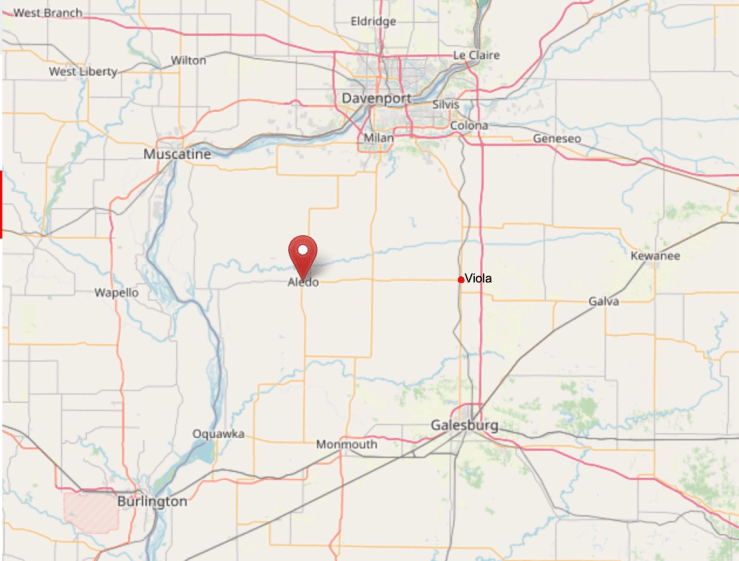
We moved from the farm, near Viola, Illinois, to Galva, Illinois, 30 miles to the east. There I started school in 1958. 

By the spring of the next year, we moved back to the Viola area, near Aledo, Illinois. I finished first grade here, attended all of second grade, but before Christmas of the third grade, we moved again, this time 44 miles west to Burlington, Iowa. I was disappointed because I had a part in the upcoming Christmas play.

I remember we spent Christmas in Burlington, but we moved again shortly after, this time 72 miles northeast to Rock Island, Illinois.

We didn’t stay long in Rock Island, either, and by spring we moved again. Our move this time took us back to my mother‘s childhood home in the small village of Millersburg, Illinois, 7 miles northwest of Aledo. 

There I would live for more than 40 years.

If you wonder why I mention the distances between towns, it is to show that we were never far from Aledo, where I was born in Mercer County Hospital in 1952 — the same hospital where my own children would be born years later. We never strayed far from our roots or our families.

My parents are gone now, so I can’t ask them why we moved so often during those three years. With the moves came job changes for Dad.

Looking back, I understand more than I did then. Those were hard years in the Midwest. Jobs weren’t always steady, and people took work wherever they could find it.

But as a child, I didn’t see any of that.

Both Mom and Dad were very hard workers — and my dad always had a job. If one ended, another one soon followed. We never went without anything. If things were tough for them, they never let us feel it.

All I knew was that we kept moving…

and somehow, we were never very far from home.

Two Longs and a Short

Party lines were a fact in the 1950s, and many rural areas didn’t convert to private lines until much later — around 1990. 

We didn’t have phone numbers in those days. We had rings. Ours was two longs and a short. 

Whenever the phone rang, everyone in the household listened carefully to see if the call was for us. When the phone rang at our house, it also rang in every other house on the party line. 

Sometimes it was hard to tell who the call was for. If you were just coming in from outdoors or another part of the house, you might not hear the entire ring.

Mom taught me the difference between our ring and those of our neighbors. I appointed myself the household sentinel to announce to the house in general — and Mom in particular — if it was indeed two longs and a short. 

The polite thing to do when answering the phone was to pick the receiver up and listen carefully for a moment to see if anyone else was already talking, then hang up if the call wasn’t for you. 

Not everyone was polite enough to follow this protocol. Some people would stay on the line and listen, a practice often referred to as rubbering. The people the call was for could usually tell someone was listening in, but only had suspicions as to who it might be. 

I wasn’t allowed to use the phone in those days — yet somehow, that old black box still found its way into my childhood.

It was a heavy, black desk telephone — the kind that seemed as solid as a small piece of furniture. A sturdy black base anchored it in place, and the handset rested across the top in a simple, unpretentious cradle. In the center sat the familiar rotary dial, its round finger holes lined with numbers that circled back toward you as you released them.

There was nothing delicate about it. The phone felt permanent, rooted to its spot on the phone table, as if it had always been there and would always remain. The cord, still straight then, stretched toward the wall in a quiet promise that this was not a toy, but a tool of connection — dependable, familiar, and woven into the ordinary rhythms of home life.

And when it rang, it carried its own unmistakable voice: two longs and a short, a sound that announced itself clearly and left no doubt that someone was calling.

The Little Red Schoolhouse

Two years after we left the farm — in the spring of my third-grade year — we moved back to Mom’s childhood home in the little village of Millersburg, where so much of our family history already lived. 

It had been a tumultuous year for me. We moved often, and I was about to enter my fourth school in as many months — the fifth since starting first grade.

The new school — the little red schoolhouse that I became so fond of — was just two blocks from home. I would be able to walk or ride my bike back and forth.

Color rendering of the Millersburg School re-created from a historic newspaper photo.

The school itself — and many of the kids who lived there — were already familiar to me. My Aunt Evelyn — Mom’s sister — lived across the street. When I visited, she often put me in touch with the neighborhood kids, so I already had playmates when we moved there.

The school was made of red brick. It was two stories tall with a bell tower on top, though the bell had been removed before I ever walked through its doors. 

There were only two classrooms — one for grades one through three and one for grades four through six. Both classrooms were on the ground floor. 

Each classroom had only one teacher. Miss Garner was mine. The teacher for the bigger kids was Mrs. Brayton. 

Upstairs was a large room where we all ate lunch and had our music lessons. We did other things there, too, like school Christmas celebrations and sometimes a class play. 

Next to it was the kitchen and the tiny library. Sometimes when I went upstairs to get a library book, I’d stop in next door to say hello to Mrs. Archer, the cook. 

When that Monday came, and Mom brought me to school for the first time, I wasn’t nervous like I was at those other schools. I knew the streets. I knew the kids. It felt like home.