Bluebells in Spring

Bluebells — one of my favorite signs of spring — usually arrived sometime in April, along with gentle breezes and a general thawing of the land.

I lived just three blocks from school, so I walked there and back each day. There was a patch of bluebells I passed twice daily. They belonged to Mrs. Joseph — an elderly neighbor — but she said she didn’t mind if I picked a few.

I was careful not to take too many, so we both could enjoy watching them grow. Mostly, I stopped to smell them — once or twice every day for as long as they bloomed — but sometimes I gathered a small bouquet for Mom. They smelled so good.

A friend showed me how to pluck a blossom from the stem, place the stem end in my mouth, and draw out what I can only assume was nectar. What a sweet surprise.

One year, I made May baskets from construction paper and filled them with small bouquets of bluebells. I left one for Mrs. Joseph, one for Mom’s best friend Marion who lived next door, and one for Mom — and felt very grown up doing it.

There were other flowers in the neighborhood, of course — many in our own yard, as Dad was an avid gardener — but nothing was ever quite so sweet as those first bluebells in spring.

The Little Red Schoolhouse

Two years after we left the farm — in the spring of my third-grade year — we moved back to Mom’s childhood home in the little village of Millersburg, where so much of our family history already lived. 

It had been a tumultuous year for me. We moved often, and I was about to enter my fourth school in as many months — the fifth since starting first grade.

The new school — the little red schoolhouse that I became so fond of — was just two blocks from home. I would be able to walk or ride my bike back and forth.

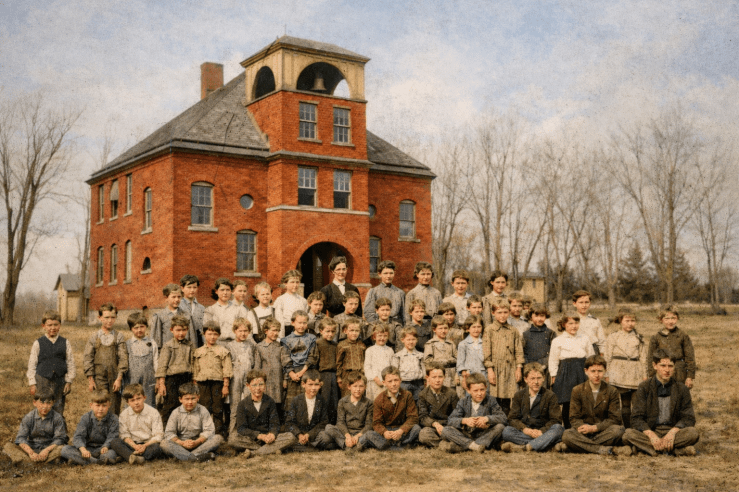
Color rendering of the Millersburg School re-created from a historic newspaper photo.

The school itself — and many of the kids who lived there — were already familiar to me. My Aunt Evelyn — Mom’s sister — lived across the street. When I visited, she often put me in touch with the neighborhood kids, so I already had playmates when we moved there.

The school was made of red brick. It was two stories tall with a bell tower on top, though the bell had been removed before I ever walked through its doors. 

There were only two classrooms — one for grades one through three and one for grades four through six. Both classrooms were on the ground floor. 

Each classroom had only one teacher. Miss Garner was mine. The teacher for the bigger kids was Mrs. Brayton. 

Upstairs was a large room where we all ate lunch and had our music lessons. We did other things there, too, like school Christmas celebrations and sometimes a class play. 

Next to it was the kitchen and the tiny library. Sometimes when I went upstairs to get a library book, I’d stop in next door to say hello to Mrs. Archer, the cook. 

When that Monday came, and Mom brought me to school for the first time, I wasn’t nervous like I was at those other schools. I knew the streets. I knew the kids. It felt like home. 

Moving from the Farm Into Town

In early summer of 1958, after school was out for Monty, we moved from our farm in Wanlock, just outside Viola, Illinois, to Galva — about 30 miles east — where my world expanded in ways I couldn’t yet begin to imagine. Life would never be quite the same. 

There were so many “firsts.” For the first time in my six years of life: 

– The wide open spaces of the farm were replaced by  houses that were built closer together with a state highway outside our front door that I was forbidden to cross. 

– We had indoor plumbing! I was fascinated by the bathtub, which Mom let me play in sometimes. That meant no more baths at the kitchen sink, and no more trips to the outhouse when it was raining or in the cold of winter. 

– I was finally old enough to start school that next fall.  I had been begging for this for a couple of years, and now my fondest wish was granted. It would impact my life in ways I could not have foreseen, and set me on a journey of learning that continues to this day. 

– I lost my best friend and constant companion —  Brownie, our farm dog. City ordinances said he had to be tied. He was clearly unhappy, so he went to live on another farm with new children to play with. 

– Monty and I had a little more freedom. The town was small, but it had a candy store in the center of town. We were occasionally allowed to walk there to spend our nickels and dimes. There was also a concrete wading pool nearby which was open to the public — but couldn’t have been more than a foot deep. I had to sit or lie down to get wet all over.

– I made new friends. Susie lived a short distance away. The Mohnen twins (both boys) lived across the street. The lady who lived opposite us on the other side of the state highway liked to hold me on her lap, but I could only go see her if Mom was with me. 

I missed the farm, but there were so many new experiences that I also enjoyed so I adjusted quickly. 

The move into town was only the beginning of a lifetime of learning and growth. 

I would never visit the farm again except for two or three times as an adult when we were in the area, a nod to the nostalgia of my childhood. But sadness in losing it never truly came, because it is deeply embedded in my memory and lives on in my stories. That is why I write them — to remember, and for them to live on in the lives of my children and grandchildren and all who come after. It is also to leave behind a small bit of history —  to tell what life was like on a northwestern Illinois farm in the 1950s.

Leaving the Farm

We lived on the farm until I was six years old. Dad sold all the animals and equipment, but he kept his milk trucks. The milk routes were one of the main reasons we moved — now he had access to two creameries instead of just one.

We moved to a new town, where I started school. Learning to read was thrilling, and it remains one of the great joys of my life. I remember Dick and Jane, and Spot and Puff, with deep fondness.

Everything was different there — city streets instead of gravel roads. We brought Brownie, of course, but a city ordinance meant he had to be tied up. We lived on a highway at the edge of town, and our small yard was a poor substitute for the acres of farmland he once roamed.

Mom and Dad said it wasn’t fair to keep him tied. He was sad — a farm dog, after all, used to chasing rabbits and running through open pastures. So Dad found him a home on a farm belonging to a good customer on one of his milk routes. I was sad, too. I missed him terribly. But Dad said Brownie was happier there, and that gave me comfort.

Over the next two years, we moved several more times to accommodate Dad’s changing business. Near the end of my third-grade year, Dad sold the milk trucks, found a better job, and purchased Mom’s childhood home in a small rural village only a few miles from the farm.

Soon after, Mom enrolled me in school — the one I came to think of fondly as The Little Red Schoolhouse. It was the same country school that Mom and her eight brothers and sisters had attended before me.

Black-and-white historic photograph of Millersburg School building with students and teachers posed in front.

Millersburg School building, which housed grades 1–8 (later
1–6) before closing in 1962. Historic photo — not my class.
Color rendering of the Millersburg School re-created from the historic photo.


The entire school, grades 1–6, fit into two classrooms. Most grades had six to eight students. Some had fewer. When I was in fifth grade, there were only four children in fourth.

It was small in a way that felt personal.

The Day I Went to School With My Brother

I wasn’t school age yet. I must have been four or five — sometime around 1956 or 1957. After watching my brother get on the big yellow school bus every morning, my mother sent me along to school with him one day.

It must have been late spring because I don’t remember needing a coat, and I’m fairly sure I wore a dress—because girls wore dresses to school then. It was one of those mild, sunlit days. That’s why I’ve always thought of it that way. 

The teacher gave me a little chair to use beside my brother’s desk. I was the only “extra” child — for which I am sure the teacher must have been grateful, but I remember feeling like one of the big kids as I colored beside him.

Recess was quite an adventure for me. There were so many kids to play with where I normally spent most of my days playing alone or with my dog, Brownie, while my brother was in school.

When recess was over, the teacher rang the bell for everyone to come back inside. It was a handheld bell, not the electric kind schools have today.


I have often wondered what led up to going to school with my brother, and why it was allowed, but there is no one left to ask how it came about. It may have been one of those end-of-the-year “bring your sibling to school” days—but that’s only my best guess.