Mom, Meet Butch!

One afternoon when I was five, my mother put me down for an afternoon nap and decided to join me.

We were both sleeping soundly when we heard those words:

“Mom, meet Butch!”

We didn’t know anyone named Butch.

Mom opened her eyes.

She was face to face with an owl.

Butch the screech owl. And my brother was holding him.

Mom wasn’t amused.

It was well-known in our family that she didn’t like birds — at least not in her face. Or in her house. Or anywhere near her. Or near us kids.

She didn’t mind them from a distance, but she said they were dirty and carried mites. I wasn’t sure what mites were, but I got the idea they were some kind of crawly bug. Turns out I was right.

I don’t remember actually seeing the bird myself. I always took my glasses off when I was sleeping so I wouldn’t break them.

My brother wasn’t in the room much longer than it took to say those few words before Mom sent him scrambling back to the barn to put the owl back where he found it — cautioning him never to do that again.

Loudly.

Butch must have been a juvenile or Monty likely couldn’t have caught him. It never occurred to me to ask.

I do know Monty never brought a bird in the house again — or any other stray animal.

Sometimes I wonder if his ears were still ringing when he got back to the barn.

Moving from the Farm Into Town

In early summer of 1958, after school was out for Monty, we moved from our farm in Wanlock, just outside Viola, Illinois, to Galva — about 30 miles east — where my world expanded in ways I couldn’t yet begin to imagine. Life would never be quite the same. 

There were so many “firsts.” For the first time in my six years of life: 

– The wide open spaces of the farm were replaced by  houses that were built closer together with a state highway outside our front door that I was forbidden to cross. 

– We had indoor plumbing! I was fascinated by the bathtub, which Mom let me play in sometimes. That meant no more baths at the kitchen sink, and no more trips to the outhouse when it was raining or in the cold of winter. 

– I was finally old enough to start school that next fall.  I had been begging for this for a couple of years, and now my fondest wish was granted. It would impact my life in ways I could not have foreseen, and set me on a journey of learning that continues to this day. 

– I lost my best friend and constant companion —  Brownie, our farm dog. City ordinances said he had to be tied. He was clearly unhappy, so he went to live on another farm with new children to play with. 

– Monty and I had a little more freedom. The town was small, but it had a candy store in the center of town. We were occasionally allowed to walk there to spend our nickels and dimes. There was also a concrete wading pool nearby which was open to the public — but couldn’t have been more than a foot deep. I had to sit or lie down to get wet all over.

– I made new friends. Susie lived a short distance away. The Mohnen twins (both boys) lived across the street. The lady who lived opposite us on the other side of the state highway liked to hold me on her lap, but I could only go see her if Mom was with me. 

I missed the farm, but there were so many new experiences that I also enjoyed so I adjusted quickly. 

The move into town was only the beginning of a lifetime of learning and growth. 

I would never visit the farm again except for two or three times as an adult when we were in the area, a nod to the nostalgia of my childhood. But sadness in losing it never truly came, because it is deeply embedded in my memory and lives on in my stories. That is why I write them — to remember, and for them to live on in the lives of my children and grandchildren and all who come after. It is also to leave behind a small bit of history —  to tell what life was like on a northwestern Illinois farm in the 1950s.

The Little Green Basket

I have always liked baskets — or virtually anything I can put treasures in. That all started when I was a little girl.

Mom gave me a small green wicker basket. Sometimes I went to the barn to gather eggs when Dad was out there, because our chickens free-ranged and liked to hang out in the hayloft. Finding their eggs was often something of an exploration, and I would usually come back with only a handful.

Other times — especially in spring or summer — I took great delight in bringing Mom baskets of dandelions, though they were usually half-closed by the time I made it back to the house.

I wasn’t allowed to roam the whole farm, nor would I have wanted to. But as long as I stayed in the yard or the adjacent barnyard, my exploring had no real limits. Sometimes I visited the rabbits in the pens Dad kept beside the barn.

By the time I brought my basket home, the dandelions had left their yellow dust on my fingers — and on my nose.

Dad used to laugh and say it was obvious I liked butter.

Barn Cat Hijinks

We had a lot of cats when we lived on the farm. Most were wild, though two or three were tame enough for me to play with. The wild ones generally stayed around the barn and didn’t come near the house except when Mom fed them.

Chaos erupted one day when one of the wild ones slipped into the house as someone opened the back door. He had never been inside before. Terrified wild-cat behavior ensued.

I remember him streaking through the house like his tail was on fire. Mom sent me into another room, but I watched from the doorway as the cat tried to escape through a closed window.

Wild-eyed, he began climbing Mom’s new sheer white curtains, shredding them as he went. She was not happy — to put it mildly.

There was no way to catch him bare-handed without inviting great bodily harm.

Careful to keep herself between me and the cat, Mom opened the door and tried shooing him onto the enclosed porch. He was having none of it.

Seeing no other solution, she grabbed a throw rug from the floor, wrapped up the cat — still clinging to the curtain — and hurled the whole furious bundle out the back door into the yard.

The curtains were ruined. It wasn’t long before we had new ones.

After his traumatic eviction, the cat was never brave enough to try the house again. In fact, I don’t remember seeing him near it after that — though Mom said he walked funny for a while.

The Day Dad Took a Chicken to Lunch

In the 1950s, Dad had another business besides farming. He ran three milk routes. Back then, farmers filled large metal cans with milk, and Dad hauled them to the creamery where the milk was turned into cheese.

Because there were multiple routes, he employed hired hands. Dad drove one route, the hired men drove the others, and when they were short a driver, Mom filled in — on top of working at the hospital and cooking lunch when she could.

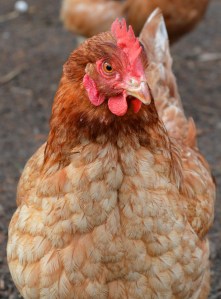
In this particular instance, it was summer and Dad and the men were putting up hay. Mom had to work, so Dad decided to take the hands into town for lunch. When they headed toward Dad’s pickup, they found one of our free-range hens settled comfortably on the muddy running board.


I never knew her real name. In my mind, she will always be Henrietta.

Dad tried to shoo her away. She objected loudly and refused to move.

He laughed, shrugged, and figured she’d hop down once the truck started rolling.

She didn’t.

To his surprise, that hen rode the entire four miles into town, feathers wind-tossed, claws gripping the mud-caked metal like a seasoned traveler who had purchased a non-refundable ticket.

Dad assumed she’d wander off while they ate.

She did not.

When he finally pulled back into our driveway after lunch, there she still sat — dignified, windblown, and entirely unbothered by the journey.

The men laughed. Dad shook his head. Life went on.

And here’s how the story ends:

Dad said that hen refused to climb down until she was good and ready. And when she finally did, he discovered she’d laid an egg right there on her perch.

Which, if you ask me, explains everything.

Some ladies simply do not vacate their seat until their business is complete.

The Bunny’s Tail Fell Off!

Although Mom grew up in a rural area, she had never lived on a farm before marrying Dad.

Mom was determined to be a good farm wife. She worked hard, kept us fed and clothed, kept the house clean, nurtured us in every way a mother should, and occasionally helped out on the farm.

Sometimes, especially when Dad was haying, she drove the tractor so a hired hand could help Dad on the ground with the square bales.

One day, she was out by the rabbit pens. I’m not sure what she was doing, but I suspect she was feeding them. Much to her horror, Dad’s prize buck made an escape.

She lunged for him, catching hold just as he started to disappear under the barn — by the tail. She held on tight and tried to pull him back out.

To her horror, the rabbit continued forward and vanished beneath the barn.

That left her standing there — with his tail in her hand and no bunny attached to it.

Later, when quietly explaining to my father what had happened to his rabbit, she said,“I didn’t know their tails would come off.”

“Their tails are delicate, and they will come off if you pull on them,” Dad told her.

I wasn’t privy to that conversation, but it’s not hard to imagine Dad’s laughter when he heard the story.

The Peanut Man

On the days Mom had to work at the hospital, I usually spent the day with Dad. Some of my fondest memories revolve around the times he took me with him to the Sale Barn. 

I don’t know if it had a name, but we always called it the Sale Barn, where farmers came to buy livestock, or brought some of their own to sell. 

There was an arena the animals were brought into for the sale, and there were bleachers where we sat high above the livestock arena. I can still hear the auctioneer’s voice as he worked through the different animals. I never had any idea what he was actually saying, but Dad seemed to know. 

And the smell—I’m sure you can imagine, but I didn’t find it particularly offensive. It just smelled like our barn, a place I loved to play.

But the real draw for me was The Peanut Man. I can’t tell you his name because I’m not sure I ever knew it. I think I may have heard it once or twice in adulthood, but he was, and always will be, The Peanut Man to me.

 He was always there with his peanut cart, dispensing bags of hot peanuts. I always wondered how he kept the peanuts hot. I never asked him, but I’m sure he would have showed me if I had. To this day I have no idea how he kept the peanuts hot. I just know that they always were. 

He was such a kind man, and he always had a smile for me. I really loved him. He was unable to speak, but he didn’t really need to. I gave him the nickel or dime my Dad gave me, and he’d turn and scoop up a brown paper bag full of hot peanuts, give me a huge smile, and hand the bag of peanuts to me. Then I would go back to where Dad was still sitting in the bleachers, and we shared that bag of peanuts. They were the best peanuts I’ve ever eaten.

I don’t know how old he was, just that he was an adult when I was a child. Everyone knew The Peanut Man in my hometown, and many remember him long after he was gone. I will never forget him. 

Ducks

My Father’s Story

I loved listening to my father tell stories, especially if they were funny. He’d laugh so hard while he was telling them that it took him much longer to tell than it would have otherwise. His laughter was contagious, and we always ended up laughing with him before we heard all of the story. A fair part of the humor in his stories was in watching the way he told them. This was one of those stories. 


One day, two men stopped by my grandfather’s farm, asking for permission to go duck hunting on his property. 

My grandfather, a salty Midwestern farmer with an enormous sense of humor who had lived long enough to see many strange sights in his life, sized them up.

It was obvious to him by the way they looked that they were city slickers — new hunting clothes, guns that didn’t look like they had ever been fired, and boots without a speck of dust on them. They went on to tell him they were in the area from Chicago for duck hunting season. Yep, city slickers, all right.

Tongue in cheek, Grandpa gave them permission, but asked them to stop by and see him before they left so he could see how many they bagged. They were off, and Grandpa could hear occasional gunshots over the course of the day. 

Late that afternoon, they were back. Each held a burlap bag partially filled with their quarry. Grandpa inspected both bags, and handed them back to the city slickers. 

“That’s a really nice bunch of ducks you’ve got there,” he told them. 

They thanked him again for allowing them to hunt on his property.

“You’re welcome. Come back any time,” he told them as they waved goodbye. 

He sure was glad to get rid of those crows. 

Dad passed away almost 35 years ago, and the last time I heard him tell that story, he was sitting at my kitchen table, laughing so hard it’s a miracle he didn’t fall off his chair. 

I can still hear the laughter, and see his face and him doubled over with it. That is how I will always remember him. 

Dickie and the Horse

January 11, 2026

Dickie and his family lived on the farm next to ours. They had a horse that I often saw standing at the pasture fence beside their house. It was big. Bigger than the horse Dad used to bring cattle in from the field—and that horse was already off-limits to me.

This one wasn’t.

I don’t remember how I got up there. Someone may have lifted me onto his back, or maybe Dickie and I climbed up on the fence and stepped over from there. What I do remember is being suddenly very high up, sitting bareback on a wide brown horse, my legs stretched farther than they were used to going.

The horse moved in a slow, steady rhythm. It felt a little like rocking in a rocking chair. My feet might have dangled, but at five years old or so, the width of his back probably kept them from going very far.

Dickie was casual about the whole thing. He wasn’t much older than I was—maybe seven—and that made it feel even more special, like this was something we were simply allowed to do.

The adults knew. Dickie had permission to take the horse out of the pasture and ride him down the road to take me home. It wasn’t a secret.

Still, I remember my mother being surprised when she saw me coming down the road, sitting so high up on that horse’s back. I don’t think she knew ahead of time.

I loved it. I was proud. I felt like I was on top of the world.

When we reached my house, Dickie stopped the horse in the front yard. Mom came out and lifted me down. I was sorry to get off. I would have happily stayed there longer.

The Day I Went to School With My Brother

I wasn’t school age yet. I must have been four or five — sometime around 1956 or 1957. After watching my brother get on the big yellow school bus every morning, my mother sent me along to school with him one day.

It must have been late spring because I don’t remember needing a coat, and I’m fairly sure I wore a dress—because girls wore dresses to school then. It was one of those mild, sunlit days. That’s why I’ve always thought of it that way. 

The teacher gave me a little chair to use beside my brother’s desk. I was the only “extra” child — for which I am sure the teacher must have been grateful, but I remember feeling like one of the big kids as I colored beside him.

Recess was quite an adventure for me. There were so many kids to play with where I normally spent most of my days playing alone or with my dog, Brownie, while my brother was in school.

When recess was over, the teacher rang the bell for everyone to come back inside. It was a handheld bell, not the electric kind schools have today.


I have often wondered what led up to going to school with my brother, and why it was allowed, but there is no one left to ask how it came about. It may have been one of those end-of-the-year “bring your sibling to school” days—but that’s only my best guess.