Waiting For the Bus in a Snow Cave

High winds, bitter cold, and swirling snow greeted us that morning as we stepped out the back door and began the walk to the bus stop at the end of our long driveway.

It was clear the walk was going to be rough. The high winds made it hard to keep our footing. 

We could tell there was a lot of snow in the driveway from the house. But our house and Nellie’s were side by side, so it wasn’t until we rounded her house that we got the full effect of it. 

The driveway was bordered on either side by wire farm fencing. It was full of snow to the tops of the fence posts, captured there by the fences themselves. 

The snow depth was almost as high as I was tall at eight years old.

In sharp contrast, the fields on either side of  the lane were windswept. 

To get to the bus stop, we had to climb up on top of the snow which, thankfully, had an icy crust strong enough to support us without breaking through.  

We could hear the wind as it skittered snow in waves across the frozen fields and the empty ribbon of highway. 

We were FREEZING by the time we got to the bus stop, the wind in our faces all the way, tiny stinging projectiles of snow assaulting every bit of our exposed skin. 

That’s when we noticed the storm had formed a snow cave in the ditch by the highway. 

The cave was big enough for us to fit inside if we crouched down. 

We ducked inside it and realized that it blocked most of the wind. It didn’t make it any warmer, but it was a relief to get out of the wind. 

Monty was a foot taller than me. He was able to see over the  tops of the drifts, so he positioned himself by the mouth of the cave so he could pop his head out occasionally and see if the bus was coming. 

Missing the bus meant missing a day of school. And neither of us wanted to try to explain that to Mom. 

After waiting about 15 minutes, the bus finally came. 

I have sometimes wondered what the bus driver thought when he saw two children suddenly pop up out of the ditch as he approached. He wouldn’t have been able to see the snow cave because the opening was facing away from the road. 

We scrambled onto the bus and were relieved to finally be inside where it was warm and out of the weather.  

On returning from school that afternoon, the wind had calmed down some, but we still had that long walk home. 

This time, we thought it might be easier walking through the field, so we jumped over the fence and walked home through the field. 

Since there was no gate on the side of the field where it bordered our house, we had to climb the wire fence when we got home. That wasn’t easy to do with frozen hands and bulky snow boots. 

The drive remained blocked for several days, so we had to repeat that walk to and from the bus daily. 

It was hard for Dad, too. Since the driveway was blocked, he had to park the car by the highway and walk home. It might have been harder for him, though, because he had to walk to the car and home again in the dark.

After Mr. Parkinson, the farmer who farmed the ground for Nellie, dug his own long drive out, he finally was able to clear our driveway. 

Many years have passed since then, and I have lived through a lot of harsh Illinois winters. But I have never seen another driveway fill completely to the tops of the fence posts or form a crust so hard we could walk on it without breaking through.

And I have certainly never waited for a school bus in a snow cave again.

The Train Tracks In Our Front Yard

Just beyond the boundary of our front yard, a railroad track ran east toward Viola and west toward Aledo. We were in between the two, but closer to Aledo.

Dad and Monty always kept our yard neatly mowed. But the strip along the tracks — the part that belonged to the railroad — was left alone. There weren’t many weeds, just tall grass.

Monty and I liked to play in it. We would mash the grass down with our feet, and those flattened spots became forts or little houses.

We spent many summer afternoons there, in the sunshine and fresh air, pretending.

Sometimes a train would come by. They didn’t go very fast, and they weren’t very long. Most were only eight or ten cars — sometimes less, sometimes more — and always with a caboose.

We knew to stay back in the yard and away from the tracks when the trains passed.

Later, I learned that it was a spur line, and the trains were delivering freight to local businesses.

Sometimes the engineer had his window open, with his arm resting on the sill. We waved, and they often waved back.

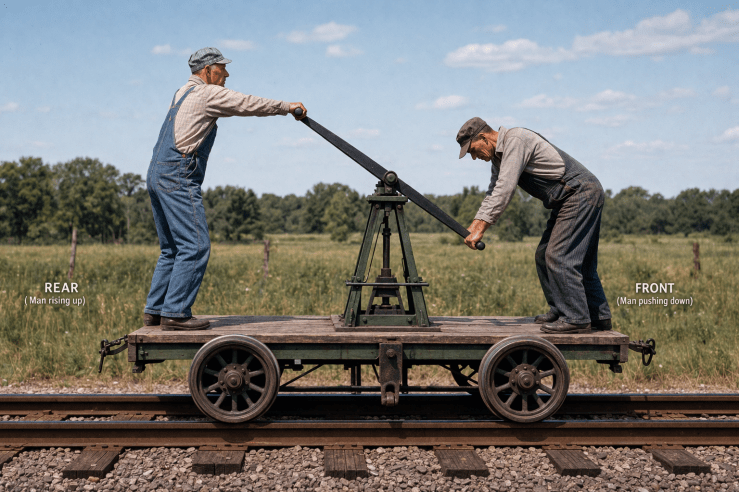
Sometimes, a handcar would come along, with two men pumping the handles to make it go.

We always thought those were funny to watch.

The Cat at the Door

Our school scheduled a PTA meeting one cold and snowy winter night. My whole family would be attending, since Monty and I were now in the same school.

When we moved to Aledo, Monty and I began attending Frew School, a three-room country school not far from our house. In those days, before school districts consolidated and country schools disappeared, it was common to have several small country schools scattered throughout a district for farm families.

As an agricultural community, there were a lot of farm kids.

Mom helped us kids get ready while she and Dad were doing the same. They were both all dressed up — Dad in a sport coat and dress slacks, and Mom in a dress and high heels. Us kids wore clean school clothes.

Once Mom was satisfied that we were scrubbed, properly dressed, and didn’t have a hair out of place, it was time to leave.

There was about a foot of snow on the ground that night. Dad had scooped a path to the car earlier, since we didn’t have a garage.

He turned the outside light on as he went out ahead of us to warm up the car. Monty and I followed a few minutes later to give it time to warm.

The three of us were sitting in the car waiting for Mom to come out. When she did, she leaned over to pet the cat who was eating out of its bowl.

The “cat” looked up and hissed.

It wasn’t a cat. It was a possum.

It turned to look at her — and that’s when she realized two beady eyes were staring at her, attached to a face with a long pointed nose and rows of sharp teeth.

POSSUM! And the cat was nowhere to be found.

She went flying across the yard — in high heels — completely ignoring the path Dad had so thoughtfully dug, and made a new path of her own to the car.

By this time, Dad, Monty, and I were laughing, watching her mad rush to the car. Because the snow was deep and had a light crust on top, she had to lift her feet high with every step. It was a sight to see, for sure.

Breathless, she opened the car door and scrambled in, slamming it hard behind her.

We were still laughing. I’m not sure she appreciated it. She didn’t say much about it other than to tell us what happened. We could tell it really scared her.

Over the years, we brought this memory up occasionally. Time softened her sense of humor, and she could relate the story with a twinkle in her eye. She forgave us for laughing at her.

Funny thing is — we didn’t even own a cat. It belonged to the farm.

Tweety Bird

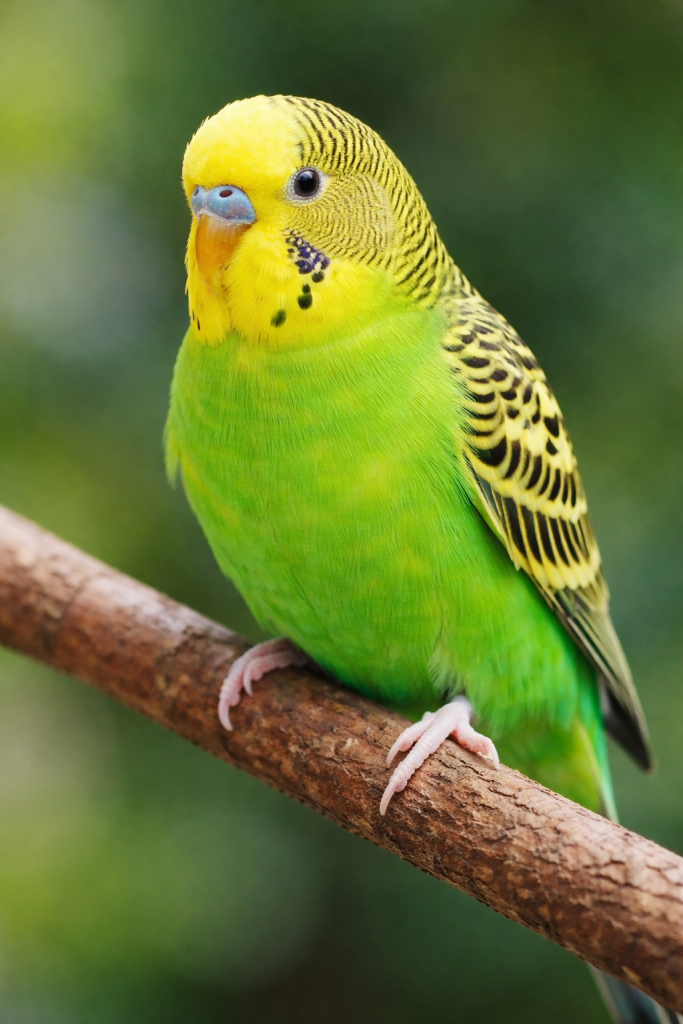
My paternal great-grandmother raised parakeets.

Tweety Bird…Not the original, but they look alike.

Whenever we went to her house, I would stand beside the bird cage and watch them. They fascinated me. It was the only time I ever got to observe birds up close.

One day, Grandma ‘Rene — her name was Irene, but everyone in the family called her Grandma ‘Rene — asked Monty and me if we would like to take one home.

Of course we said yes! We were so excited.

Given Mom’s slight aversion to birds, she was less enthused, but she allowed it.

Grandma gave us a cage, and we took him home.

Monty and I named him Tweety Bird after the cartoon character.

Cleaning the cage fell to Mom. She was an excellent housekeeper, so she cleaned it often. When the weather was nice, she took the cage outside and cleaned it on the sidewalk.

The last time she cleaned it… was the last time she cleaned it.

She had set the cage down on the sidewalk and slid the removable bottom out so she could clean it properly.

Unfortunately, she forgot to slide it back in before she picked up the cage.

Before she could react, Tweety Bird saw his opportunity — and he was a caged bird no more.

Mom said he flew up into the tree by the back door, but there was no way she could catch him.

He soon flew away, never to be seen again.

I think she felt bad when she had to tell us what happened when we came home from school.

We knew it was an accident, and she really did feel bad — but we couldn’t resist teasing her that we thought she did it on purpose because we knew she wasn’t fond of birds.

The Lawn Chair Incident

In the summer and on Saturdays, my brother and I usually went with Mom when she ran the milk route for Dad.

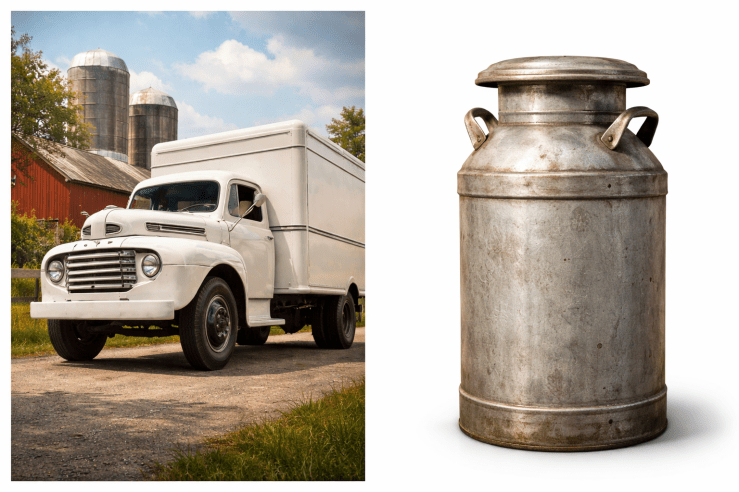
It wasn’t unusual for them to stop for a little while to chat with the people they had become friends with, although they couldn’t stay long because the milk trucks in those days were not refrigerated.

One afternoon, Mom stopped to visit with a farmer and his wife. She went inside the house, but Monty and I stayed outdoors.

It was a beautiful day—warm, with blue skies and plenty of sunshine. We decided to sit in the folding lawn chairs under a shade tree.

I don’t remember what we were talking about, but Monty sat in his chair with his long legs touching the ground. My legs were much shorter, so I sat on the edge of the chair, swinging my feet.

That’s when disaster struck.

My position on the chair and the motion of swinging my feet caused it to fold up—catching my ring finger on my right hand between two pieces of metal. My weight pressed down hard on my smashed finger.

I started screaming at the top of my lungs.

Monty ran to get Mom, but he didn’t make it as far as the house before all three adults came tearing out and rushed to my side.

The farmer tried to unfold the chair, but he couldn’t. He grabbed some tools to take it apart, but he became frantic—probably because I was still screaming.

He partially took the chair apart… and partially ripped it apart.

I heard Mom say something about not ruining his chair, and he said he didn’t care. There were some curse words in there too, but I don’t remember what they were.

The only choice was to take me to the hospital.

Since Mom’s only transportation was the milk truck, the farmer bundled us into his car after his wife gave Mom a white cotton dish towel to wrap around my finger.

The only access to the highway to Hammond-Henry Hospital in Kewanee was a narrow gravel road with long, steep hills.

The farmer was in a hurry, so he drove as fast as he safely could.

I had stopped screaming once my finger was released from the chair, but now I was sobbing.

I sobbed all the way up the first hill…

…and laughed all the way down it.

The sudden drop always made me laugh.

As soon as we started up the next hill, I cried again—then laughed all the way down.

I think there were three hills in all, and it happened every time.

When we finally ran out of hills, I cried all the way to the hospital.

Fortunately, my finger wasn’t broken. The doctor bandaged it and sent me home.

After taking us back, Mom finished the milk route, although I don’t remember the rest of it.

It didn’t take long for me to realize that if I let my arm drop to my side, my finger started to throb—so I held it close to my chest for the rest of the afternoon.

When we got home, Mom made a sling for me out of a dish towel.

I was pretty proud of that sling.

To this day, that same finger is still slightly smaller than the ring finger on my left hand. It’s less noticeable now, and I doubt anyone else would see it…

…but I do.

Because I know what caused it.

No Brakes on Main Street

Mom was running the Kewanee milk route for Dad one day, picking up milk in big heavy cans and hauling them to the Galva Creamery Company. Dad had a deal worked out with the farmers so they loaded the cans for her. When Dad ran the route, he usually helped them.

Monty and I were with her that day. We had been singing songs like we usually did. Our favorites were The Marine’s Hymn and The Caissons Go Rolling Along.

Suddenly, Mom stopped singing and told us to get down on the floor. She didn’t shout, but we could tell by the tone of her voice that she meant business. We didn’t question it—we got down immediately.

We asked her what was wrong.

“The engine died,” she said. “When the engine dies, the air brakes don’t work.”

I had been looking through the windshield just before she told us to get down. We were a little less than halfway down a hill.

The light at the bottom of the hill turned red.

That meant the cross traffic had the right of way.

I remember seeing the cars sitting there at the intersection.

I’m guessing the drivers saw the crazy people in the big runaway milk truck coming down the hill a little too fast and decided it might be best to stay right where they were.

Mom gripped the big steering wheel and kept the truck pointed straight down the hill.

The truck was heavy with a full load of milk cans. Once it started downhill, there was no way to stop it without brakes.

My stomach did that flip-flop thing it does when you go down a hill too fast. Usually it made me laugh.

This time it didn’t.

It all happened so fast. We made it through the stoplight without mishap. We were still rolling, but Mom finally got the engine started again and pulled off to the side of the highway.

We waited there for a few minutes. Then Mom pulled back into traffic and continued on to the creamery in Galva.

I was only six years old, but that is something I will never forget.

First Grade

Around the time I first started school, I went shopping with Mom, Dad, and Monty for school supplies. I was so excited! I remembered the years when my brother went to school and I had to stay behind. Now I would never be left behind again.

When we got to the store, it was decided that Dad would help me pick out my supplies while Mom helped Monty. When everything had been chosen, Dad paid for the supplies. He was still carrying my tablet under his arm.

We left the store and had only gone a few feet when I heard him say, “Oh, no! I forgot to pay for the tablet.”

Without another word, he turned around and went back into the store — still clutching it to his chest — and apologized to the clerk for the mistake.

The only real experience I had with school before starting myself was the day I went with my brother — a memory I’ve written about before.

I can’t remember the exact first day of school. What I do remember is the school and the classroom itself.

The school was a tall, square building made of dark brick. It stood exactly one block from home. I couldn’t guess what school would be like, but I was anxious to find out.

I remember the inside of my classroom — from the wall of windows where the light filtered through the oak trees outside, to the crayon color chart on the wall with the names of each color printed in bold lettering. I remember my cubby, too. We each had one with our name printed on it to keep our nap rugs in.

We would move again before the end of the school year, but this is where I met Dick and Jane, Baby Sally and their pets, Spot and Puff. It is also where I learned that colors had names that I could write and someone else could read — and that classical music could make a child sit still and listen… and imagine.

Mom, Meet Butch!

One afternoon when I was five, my mother put me down for an afternoon nap and decided to join me.

We were both sleeping soundly when we heard those words:

“Mom, meet Butch!”

We didn’t know anyone named Butch.

Mom opened her eyes.

She was face to face with an owl.

Butch the screech owl. And my brother was holding him.

Mom wasn’t amused.

It was well-known in our family that she didn’t like birds — at least not in her face. Or in her house. Or anywhere near her. Or near us kids.

She didn’t mind them from a distance, but she said they were dirty and carried mites. I wasn’t sure what mites were, but I got the idea they were some kind of crawly bug. Turns out I was right.

I don’t remember actually seeing the bird myself. I always took my glasses off when I was sleeping so I wouldn’t break them.

My brother wasn’t in the room much longer than it took to say those few words before Mom sent him scrambling back to the barn to put the owl back where he found it — cautioning him never to do that again.

Loudly.

Butch must have been a juvenile or Monty likely couldn’t have caught him. It never occurred to me to ask.

I do know Monty never brought a bird in the house again — or any other stray animal.

Sometimes I wonder if his ears were still ringing when he got back to the barn.

A Little Dab Will Do

In the 1950s, Brylcreem was as common in Midwestern households as toothpaste.

One morning while Mom was getting Monty ready for school, she was combing his hair and absent-mindedly reached for the Brylcreem. She started distributing it through his hair and realized something was different — it was thick and white and did not blend into his hair. 

Glancing at the tube she held in her hand, she discovered she had rubbed toothpaste through his hair.

What to do? The bus would be there any minute. 

I was watching them from across the kitchen. She looked at me, shrugged, and quickly washed his hair. 

In those days, we didn’t have running water. We also didn’t have hot water. What we did have was an old hand pump at the kitchen sink that only brought in cold water. Cold well water. 

Monty went to school with wet hair that morning. I expect that was the only time in his life he had his hair washed with shampoo and cold water. Brrr. 

Brylcreem, a little dab’ll do ya — that is what the television commercials said. That morning, a little dab definitely did not do. 

The Penny Jar

One summer, a teenage cousin came to stay with us for a short time to help Dad at haying time and earn a little money in the process. Let’s call him Jack. 

Since our family was using all of the bedrooms on the ground floor, Mom gave Jack one of the rooms upstairs to use while he was with us. 

Monty and I usually didn’t go upstairs, but we must have followed Mom up there when she made the bed and tidied up. That’s when we discovered the penny jar on his dresser. 

It was my brother who began teasing him that we were going to take the pennies in his penny jar when he was out helping Dad — and of course I chimed in. 

Jack didn’t seem to have much of a sense of humor when it came to his money, which made it all the more tempting to tease him. 

So, Jack told Mom that we said we were going to take his precious pennies. We weren’t of course, and Mom told him so. 

I don’t think he took much comfort in that, though. He didn’t stay very long. 

Jack is still alive, though I haven’t seen him in more than fifty years.

I sometimes wonder if he’s still guarding a penny jar somewhere — and if he’s still mad at two farm kids who never actually took a single penny.