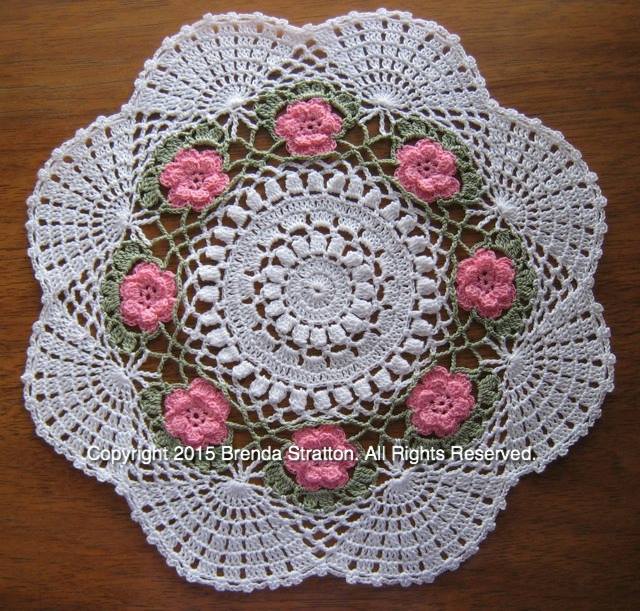
Mom was sitting on the end of our black sectional sofa, the one with silver threads running through it, crocheting a doily. It wasn’t the first time I had seen her crochet—but it was the first time I really paid attention.
I sat down beside her to watch.
She was working with dark pink and forest green crochet thread, two of her favorite colors.
I wanted to understand how she formed the stitches that made the doily grow. Her quick hand movements—and the steady progress of the piece—fascinated me.
I watched her for a long time that day. And after that, whenever she sat down to crochet, I often sat beside her to watch.
I couldn’t figure out how she did it, but I wanted to learn.
She didn’t think my seven-year-old hands would be able to manage a tiny steel hook and thread, so she gave me a blue plastic crochet hook and a ball of bright pink yarn.
She taught me how to make a chain stitch. I used up most of that yarn making one very long chain.
She tried to show me how to turn those chains into something more, but I lost interest before I had much success. It would be years before I picked it up again.
Later, when I was about eleven, a friend taught me to knit in garter stitch. I made a lot of knitted headbands that year.
In my late teens, I picked knitting up again for a while—but I was never completely comfortable working with two needles.
It felt awkward.
That’s when I turned back to crochet.
I taught myself the basic stitches from a book and quickly realized that working with a single hook felt far more natural.
As I became more invested, I learned advanced techniques and began making hats, baby blankets, purses, mittens—even rugs.
Before long, I realized I could look at a finished piece and write a pattern from it.
That led to designing my own patterns.
Eventually, I became confident enough to submit them for publication.
The first few were turned down, but I was determined. Each rejection taught me something. I studied my work, paid attention to what publishers were accepting, and adjusted.
Before long, more and more of what I submitted was accepted.
That was the beginning of what became a decades-long career in crochet design.
Rose Garden, a doily I designed many years later. Mom would have loved this one.
In 2004, that path led me to accept an editorial position with a Midwest craft publishing company, where I worked for several years before retiring.
I have long since lost track of that first ball of bright pink yarn—but I still have the blue plastic crochet hook Mom gave me.
Over the years, I’ve collected many hooks—favorites I reach for again and again—but none of them compare to that simple blue plastic one.
That one holds the memories.
Memories of sitting beside Mom as she worked with a tiny steel hook, creating what felt like magic out of thin air.
I’ve often told people that Mom taught me to crochet, because she was the first to put a hook in my hands.
She always gently corrected me, saying it was the other way around—that I taught her by passing along what I had learned.
Either way, she was my inspiration in crochet—and in so many other things in life.
And to think… it all started with watching Mom crochet.
I was seven years old when I asked my teacher about the mole on her arm.
She had dark hair and fair skin, like me. I had freckles—lots of them—and I was curious. Children are not subtle. If we notice something, we ask about it.
Instead of brushing off my question, she answered gently.
She told me that because I had so many freckles, I should keep an eye on them. She pointed to one on my upper arm in particular and said I should watch it in case it ever wanted to be something else.
She didn’t frighten me.
She didn’t lecture me.
She simply planted a seed of awareness.
And I listened.
For two days, I tried to remember her name.
Then I said her first name out loud—Mary Jane—and “Clawson” came back immediately. I have always liked her name.
Thirty years later, I remembered.
I was thirty-eight years old when that freckle on my upper arm began to change. It developed tiny flecks of blue that hadn’t been there before. It didn’t look dramatic. It didn’t hurt. But it didn’t look the same anymore.
Because of what she had told me when I was seven, I had watched it over the years. Not obsessively. Just attentively.
Around that same time, my youngest son didn’t want to go to school one morning. He said he felt sick. I wasn’t entirely sure I believed him, but I took him to the doctor that day.
By the time we were in the exam room, he seemed fine. The doctor couldn’t find anything wrong. Since we were already there, I asked him to look at the freckle on my arm.
He examined it once—just once—and scheduled me for surgery.
It was malignant melanoma.
Scott was eight at the time. The other kids were teenagers, but they still needed their mother.
So I did what needed to be done.
The surgeon removed the melanoma along with a generous margin of surrounding tissue. I carry the scar on my upper left arm to this day, and another on my leg from the skin graft that closed the wound.
I was seven when Mary Jane Clawson told me to watch that freckle.
I was thirty-eight when I remembered.
She never knew what her quiet advice would mean to me.
When I was in second grade, Mrs. Clawson asked me to help the younger children learn to read.
She gave me a copy of the reader they were using and told me which story they were working on. Since it was the same reader I had used the year before, I already knew the stories.
The desks were lined up in neat rows, all facing the blackboard.
I would pull a little chair up beside a student’s desk and listen while they read out loud. When a child came to a word they didn’t know, I encouraged them to sound it out. If that didn’t help, I would tell them the word.
There was something satisfying, even at the age of seven, about being able to help.
I really enjoyed it — and I was proud that Mrs. Clawson trusted me to do it.
Of course, I had my own work to do, but if I finished early and she needed someone to listen to the first graders read, she would ask if I would like to help. I always did.
The next year, when I started third grade, I moved to a different classroom. Even then, there were times when Mrs. Clawson asked my new teacher, Miss Nesbitt, if I could come back and listen to her students read.
I didn’t know it at the time, but I suppose that was my first experience as a tutor.
We stayed in Galva through Christmas of 1958. I remember the colored lights, and Mom letting me help put tinsel on the tree for the first time.
I turned seven a month later. Soon after that, it was time to move again.
I liked living in Galva a lot. It was different from the farm in a lot of ways.
City streets instead of gravel roads.
Walking to school. I loved school — especially learning to read.
I had school friends to play with. Some lived close enough that I could walk to their houses after school.
Dad sold his milk trucks, and soon we were on our way.
We moved west again, this time just east of Aledo along Illinois Route 17.
Our new home sat halfway between our old farm near Viola and where Mom had grown up, northwest of Aledo in Millersburg.
It is the same general area I had always lived in, except for the nine months or so we lived in Galva.
As much as I liked living in town, I was also glad to be back on the farm, even if it wasn’t the same farm. This time, Dad wasn’t farming. We moved into a tenant house next door to Nellie Briggs, the lady who owned the farm. Someone else farmed the land for her.
Our little tenant house was much smaller than the stately white main house, but it was cute and very well kept. It had only two bedrooms, but we made it work with our bunk beds.
There was one thing about this house that worried me, though. The heat came from pipes in the walls, which I wasn’t used to. I thought the heat meant it could catch on fire, but Mom assured me it was safe. She said the house was heated by a system of water pipes in the walls. It was warmed by the coal furnace in the basement.
Just in case, though, I always had a backup plan — in case we ever did have a fire. I would smash the window next to my bed with Jocko, my teddy bear.
Fortunately, that plan was never needed.
Not long after we moved into the tenant house near Aledo, Mom took me to register at Frew School.
I didn’t expect much from today when I woke up this morning. The only thing on my agenda was to catch up on some laundry.
My day starts off like usual… feed the dog, feed myself, dispense meds, and get started.
After Gracie, my fifteen-year-old Shih Tzu, and I eat breakfast, I load the dishwasher and tackle the laundry.
I have way too many clothes—a result of gaining control of my diabetes and losing weight. I now have two sizes of clothes: what I wore before, and what I can wear now.
I am sorting through the larger clothes so I can pass them along, keeping a few oversized T-shirts because they’re comfortable. They also make great work shirts.
We’re in that in-between stretch where the seasons can’t quite make up their minds, so I’m trying to put my winter clothes away. That can get tricky here in the Midwest. Just when it feels like spring has settled in, winter rushes back and says, “Not so fast.”
I am packing the clothes I can no longer wear so I can pass them along. The winter clothes I still wear will go into storage—soon, once I’m sure Mother Nature is finished playing seasonal roulette with the weather.
But it’s not just about the clothes. It’s the space they take up—and what they represent.
The same is true for so many other things in my house.
I’m transitioning my office from designer Brenda to writer Brenda.
There are still too many pots and pans and small appliances in my kitchen—more than I need now. My family is smaller, and I don’t cook the way I used to when Carl and all four children were here.
I don’t need all of this anymore. I’m still figuring out what stays—and what it means to let the rest go.
While I was folding laundry this afternoon, I happened to think of this little cardboard sign I hung on the wall in the kitchen of my first apartment.
I thought it was a cute saying, and would be a reminder to keep my apartment tidy. But I also liked the fact that it was printed in a psychedelic color scheme because—1970.
I currently find myself in the process of downsizing. That little quote seems just as true today as it was in 1970. It seems like the more I do, the more I find that still needs to be done.
But, the meaning has shifted since I hung that sign so long ago. It’s not so much that I am behind now, as it is that I am just in the middle of things.
I don’t like getting behind in my work, it’s true. I never have, especially in my professional life.
But now, it is less clear where to start and where the middle happens, although the end is clear. I want more space and fewer belongings.
What I’m finding is that it isn’t so simple to lay the job out in a straight line like I’ve done most of my life.
I often find I can’t take the next step in one job because something else has to be done first.
A case in point… I live in a multi-level home. I am getting older, so I am trying to minimize the times I have to go up and down stairs every day.
I want to create a space on a shelf to keep a few convenience foods, some things I can quickly grab for a no-fuss lunch or dinner. But before I can do that, I have to clear the shelf.
With clearing the shelf comes deciding whether to move the items to a different location or let them go.
Maybe I’m not getting behind after all.
Maybe there is no exact starting point.
Maybe it’s enough to just begin—wherever I am—and work my way through it, one piece at a time.
Around the time I first started school, I went shopping with Mom, Dad, and Monty for school supplies. I was so excited! I remembered the years when my brother went to school and I had to stay behind. Now I would never be left behind again.
When we got to the store, it was decided that Dad would help me pick out my supplies while Mom helped Monty. When everything had been chosen, Dad paid for the supplies. He was still carrying my tablet under his arm.
We left the store and had only gone a few feet when I heard him say, “Oh, no! I forgot to pay for the tablet.”
Without another word, he turned around and went back into the store — still clutching it to his chest — and apologized to the clerk for the mistake.
The only real experience I had with school before starting myself was the day I went with my brother — a memory I’ve written about before.
I can’t remember the exact first day of school. What I do remember is the school and the classroom itself.
The school was a tall, square building made of dark brick. It stood exactly one block from home. I couldn’t guess what school would be like, but I was anxious to find out.
I remember the inside of my classroom — from the wall of windows where the light filtered through the oak trees outside, to the crayon color chart on the wall with the names of each color printed in bold lettering. I remember my cubby, too. We each had one with our name printed on it to keep our nap rugs in.
We would move again before the end of the school year, but this is where I met Dick and Jane, Baby Sally and their pets, Spot and Puff. It is also where I learned that colors had names that I could write and someone else could read — and that classical music could make a child sit still and listen… and imagine.
There have been many times in my life when I’ve wondered if I was doing things the right way.
That question has come up for me in more ways than I can count.
As a mother, I have wondered if I was being too strict… or too permissive.
What I learned goes back to something my mother told me many years ago—something that has stayed with me ever since:
“If you do the best you can with the information you have at the time, that is all anyone can do.”
I’ve always tried to do the right thing, even when I wasn’t sure what the right thing was.
All I could do was look at the situation, consider what I knew at the time, and make the best decision I could.
Did I make mistakes along the way? Of course I did. That’s part of being human.
There were times I wished things had turned out differently. I spent years going back over those moments, thinking about what I could have done better—even though the outcome never changed.
Somewhere along the way, I equated doing my best with doing things perfectly.
And when things didn’t turn out the way I hoped, I held onto that as regret.
It took me a long time to understand something I hadn’t seen before.
“I can’t judge what I did forty years ago by who I am today.”
I am not perfect. I never was, and I never will be.
But I did the best I knew how to do at the time—and that has to be enough.
In early summer of 1958, after school was out for Monty, we moved from our farm in Wanlock, just outside Viola, Illinois, to Galva — about 30 miles east — where my world expanded in ways I couldn’t yet begin to imagine. Life would never be quite the same.
There were so many “firsts.” For the first time in my six years of life:
– The wide open spaces of the farm were replaced by houses that were built closer together with a state highway outside our front door that I was forbidden to cross.
– We had indoor plumbing! I was fascinated by the bathtub, which Mom let me play in sometimes. That meant no more baths at the kitchen sink, and no more trips to the outhouse when it was raining or in the cold of winter.
– I was finally old enough to start school that next fall. I had been begging for this for a couple of years, and now my fondest wish was granted. It would impact my life in ways I could not have foreseen, and set me on a journey of learning that continues to this day.
– I lost my best friend and constant companion — Brownie, our farm dog. City ordinances said he had to be tied. He was clearly unhappy, so he went to live on another farm with new children to play with.
– Monty and I had a little more freedom. The town was small, but it had a candy store in the center of town. We were occasionally allowed to walk there to spend our nickels and dimes. There was also a concrete wading pool nearby which was open to the public — but couldn’t have been more than a foot deep. I had to sit or lie down to get wet all over.
– I made new friends. Susie lived a short distance away. The Mohnen twins (both boys) lived across the street. The lady who lived opposite us on the other side of the state highway liked to hold me on her lap, but I could only go see her if Mom was with me.
I missed the farm, but there were so many new experiences that I also enjoyed so I adjusted quickly.
The move into town was only the beginning of a lifetime of learning and growth.
I would never visit the farm again except for two or three times as an adult when we were in the area, a nod to the nostalgia of my childhood. But sadness in losing it never truly came, because it is deeply embedded in my memory and lives on in my stories. That is why I write them — to remember, and for them to live on in the lives of my children and grandchildren and all who come after. It is also to leave behind a small bit of history — to tell what life was like on a northwestern Illinois farm in the 1950s.