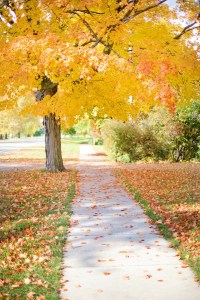
Autumn Leaves and Training Wheels

Leaves crunched under my feet. The tall oak trees surrounding our school were alive with color as the blue sky and late afternoon sun filtered through them. The crisp autumn air held the faint scent of burning leaves somewhere in the neighborhood.

I was six years old, and the sheer beauty of the day felt like it was wrapped around me.

We had moved into town a few months earlier. Our house and the school were only a block apart, both along the highway that ran through town.

My friend, Susie, and I had agreed to meet back at school that day. She had received a new bike with training wheels for her birthday, and she told me she would teach me to ride it. But first, we had to go home and ask our mothers if it was okay.

Mom gave me permission, but reminded me to stop, look, and listen before crossing the street—and not to cross the highway under any circumstances.

Susie met me at the school a short time later, and that’s how I learned to ride a bike.

Susie rode it first, showing me what to do.

Soon it was my turn.

At first, I just sat on the bike. Then I slowly started pedaling. It wasn’t quite as easy as it had looked when Susie rode it. The handlebars wobbled, and I felt a flicker of frustration.

But once the wheels began to move and I found the rhythm of it, the wobble settled. By the time we reached the end of the block, I was more proud than frustrated.

Susie kept pace alongside me to the other end of the block. I turned the bike around, and she rode it back while I kept pace with her.

We continued in this way for a while, until the sun got lower in the sky and we knew it was time to go home.

By then, I was pretty sure I wanted a little bike with training wheels of my own.

I crossed the street toward home, the sound of leaves still crunching under my shoes, carrying the whole golden afternoon with me.

Moving from the Farm Into Town

In early summer of 1958, after school was out for Monty, we moved from our farm in Wanlock, just outside Viola, Illinois, to Galva — about 30 miles east — where my world expanded in ways I couldn’t yet begin to imagine. Life would never be quite the same. 

There were so many “firsts.” For the first time in my six years of life: 

– The wide open spaces of the farm were replaced by  houses that were built closer together with a state highway outside our front door that I was forbidden to cross. 

– We had indoor plumbing! I was fascinated by the bathtub, which Mom let me play in sometimes. That meant no more baths at the kitchen sink, and no more trips to the outhouse when it was raining or in the cold of winter. 

– I was finally old enough to start school that next fall.  I had been begging for this for a couple of years, and now my fondest wish was granted. It would impact my life in ways I could not have foreseen, and set me on a journey of learning that continues to this day. 

– I lost my best friend and constant companion —  Brownie, our farm dog. City ordinances said he had to be tied. He was clearly unhappy, so he went to live on another farm with new children to play with. 

– Monty and I had a little more freedom. The town was small, but it had a candy store in the center of town. We were occasionally allowed to walk there to spend our nickels and dimes. There was also a concrete wading pool nearby which was open to the public — but couldn’t have been more than a foot deep. I had to sit or lie down to get wet all over.

– I made new friends. Susie lived a short distance away. The Mohnen twins (both boys) lived across the street. The lady who lived opposite us on the other side of the state highway liked to hold me on her lap, but I could only go see her if Mom was with me. 

I missed the farm, but there were so many new experiences that I also enjoyed so I adjusted quickly. 

The move into town was only the beginning of a lifetime of learning and growth. 

I would never visit the farm again except for two or three times as an adult when we were in the area, a nod to the nostalgia of my childhood. But sadness in losing it never truly came, because it is deeply embedded in my memory and lives on in my stories. That is why I write them — to remember, and for them to live on in the lives of my children and grandchildren and all who come after. It is also to leave behind a small bit of history —  to tell what life was like on a northwestern Illinois farm in the 1950s.