In the Kitchen with Captain Kangaroo

Most mornings of my early childhood began in the kitchen, sitting in my little upholstered rocking chair, watching Captain Kangaroo.

The kitchen was the warmest room in the house in winter, and it was where my mother spent most of her day. While I watched television, she cooked, baked, and moved quietly around me. The air always smelled of something good. I felt safe there. Cozy. Loved.

I don’t remember the house being cold — but I suppose it must have been, especially the floors. Instead of slippers, Mom bought me a pair of ankle-high fur-lined snow boots to wear in place of slippers. She had a pair just like them in her own size. We matched. I liked that. 

Captain Kangaroo, Mr. Green Jeans, Bunny Rabbit, Grandfather Clock, and Dancing Bear felt like members of our household. They were part of my mornings, part of my growing up.

Our farmhouse had no central heating, like many rural homes in the 1950s. Two oil stoves heated the main floor — one near the bedrooms, one in the kitchen — and none upstairs, which we used mostly for storage. Winters were cold in the Midwest, and that was especially evident in our living room, caught between the two stoves. So my parents brought a television into the kitchen instead. A portable set with rabbit ears. And a child-sized upholstered rocking chair just for me.

There was a long counter along the west wall with no cabinets underneath. That became my little house. I played there for hours. Close enough that Mom could see me, far enough that neither of us would trip over the other. I didn’t know it then, but it was the perfect arrangement.

Where my mother was, I was.

And where that little rocking chair sat — that was home.

Bloomers


Dad used to buy livestock feed in colorful linen bags, which he saved and brought home to Mom. She loved to sew, and she turned them into pretty and useful things for us and for the house.

I remember once she made some bloomers for me. That’s what she called them, but they didn’t look like the old-fashioned type that girls and women wore under dresses in earlier eras. I would compare them to the little matching panties that are sold with toddler dresses today.

They were pretty and ruffly, and I loved them. I was pretty proud of them.

One morning, I followed my brother to the bus because I wanted to show the kids my pretty new bloomers. I think that was all I was wearing.

I don’t remember ever walking to the bus with him after that.

I suspect I embarrassed him and he asked Mom to keep me in the house.

Big brothers have their limits.

Leaving the Farm

We lived on the farm until I was six years old. Dad sold all the animals and equipment, but he kept his milk trucks. The milk routes were one of the main reasons we moved — now he had access to two creameries instead of just one.

We moved to a new town, where I started school. Learning to read was thrilling, and it remains one of the great joys of my life. I remember Dick and Jane, and Spot and Puff, with deep fondness.

Everything was different there — city streets instead of gravel roads. We brought Brownie, of course, but a city ordinance meant he had to be tied up. We lived on a highway at the edge of town, and our small yard was a poor substitute for the acres of farmland he once roamed.

Mom and Dad said it wasn’t fair to keep him tied. He was sad — a farm dog, after all, used to chasing rabbits and running through open pastures. So Dad found him a home on a farm belonging to a good customer on one of his milk routes. I was sad, too. I missed him terribly. But Dad said Brownie was happier there, and that gave me comfort.

Over the next two years, we moved several more times to accommodate Dad’s changing business. Near the end of my third-grade year, Dad sold the milk trucks, found a better job, and purchased Mom’s childhood home in a small rural village only a few miles from the farm.

Soon after, Mom enrolled me in school — the one I came to think of fondly as The Little Red Schoolhouse. It was the same country school that Mom and her eight brothers and sisters had attended before me.

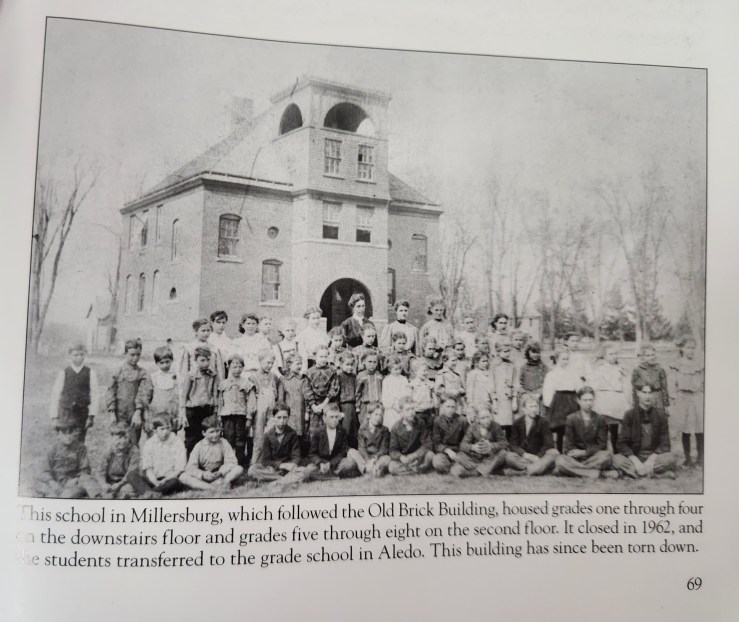
Black-and-white historic photograph of Millersburg School building with students and teachers posed in front.

Millersburg School building, which housed grades 1–8 (later
1–6) before closing in 1962. Historic photo — not my class.
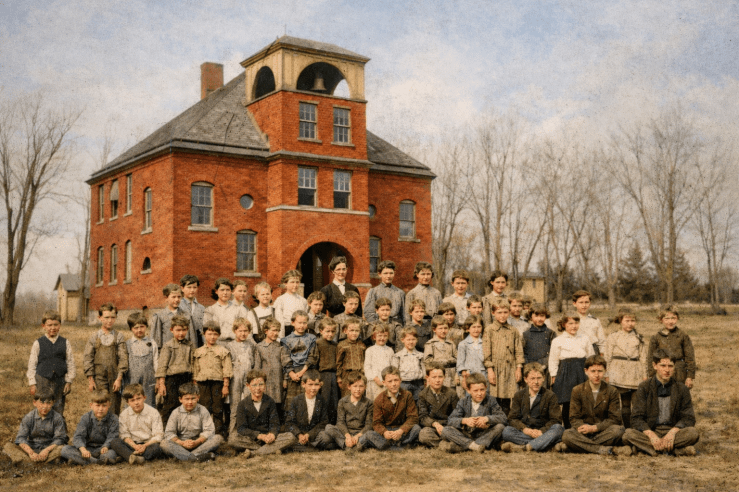
Color rendering of the Millersburg School re-created from the historic photo.


The entire school, grades 1–6, fit into two classrooms. Most grades had six to eight students. Some had fewer. When I was in fifth grade, there were only four children in fourth.

It was small in a way that felt personal.

Dad Measured My Backside

Our farmhouse sat on top of a hill. The yard and driveway sloped gently down to the gravel road that passed our house and connected the community. That hill, and everything on it, shaped my early childhood. 

In the front yard were two trees. One was a tall pear tree, but I only know that because I heard my parents say so. I’m not sure what the other one was. It was broader and had a long limb that someone had hung a porch swing from — the kind that several people could sit in. I liked it and sat in it from time to time, but I couldn’t really swing — my legs were too short. 

Mom and Dad decided I needed a swing of my own, one that was just the right height for my short little legs to reach the ground. 

One sunny afternoon, they announced that today was the day I would get my new swing. I was so excited!

Dad gathered the materials — a rope, a board, a hand saw, and a drill. When he had everything together, he called us outside. I watched as he tossed the ends of the rope over the limb of the pear tree, then secured them in place. 

Next, he told me to turn around and bend over. I didn’t question it — grownups always knew what they were doing — so I did.

“I have to measure you to make sure I cut the board wide enough,” he said. He didn’t use a measuring tape. He just held the board up behind me. 

Mom told me many years later that what I didn’t see was the grin on his face and the wink he gave her when he said it. 

I loved that swing. Since the yard sloped, I felt like I was swinging a lot higher than I actually was because of it. 

The Day Dad Took a Chicken to Lunch

In the 1950s, Dad had another business besides farming. He ran three milk routes. Back then, farmers filled large metal cans with milk, and Dad hauled them to the creamery where the milk was turned into cheese.

Because there were multiple routes, he employed hired hands. Dad drove one route, the hired men drove the others, and when they were short a driver, Mom filled in — on top of working at the hospital and cooking lunch when she could.

In this particular instance, it was summer and Dad and the men were putting up hay. Mom had to work, so Dad decided to take the hands into town for lunch. When they headed toward Dad’s pickup, they found one of our free-range hens settled comfortably on the muddy running board.


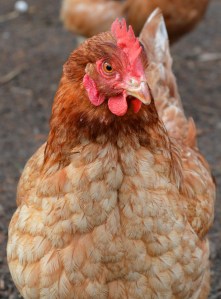
I never knew her real name. In my mind, she will always be Henrietta.

Dad tried to shoo her away. She objected loudly and refused to move.

He laughed, shrugged, and figured she’d hop down once the truck started rolling.

She didn’t.

To his surprise, that hen rode the entire four miles into town, feathers wind-tossed, claws gripping the mud-caked metal like a seasoned traveler who had purchased a non-refundable ticket.

Dad assumed she’d wander off while they ate.

She did not.

When he finally pulled back into our driveway after lunch, there she still sat — dignified, windblown, and entirely unbothered by the journey.

The men laughed. Dad shook his head. Life went on.

And here’s how the story ends:

Dad said that hen refused to climb down until she was good and ready. And when she finally did, he discovered she’d laid an egg right there on her perch.

Which, if you ask me, explains everything.

Some ladies simply do not vacate their seat until their business is complete.

The Bunny’s Tail Fell Off!

Although Mom grew up in a rural area, she had never lived on a farm before marrying Dad.

Mom was determined to be a good farm wife. She worked hard, kept us fed and clothed, kept the house clean, nurtured us in every way a mother should, and occasionally helped out on the farm.

Sometimes, especially when Dad was haying, she drove the tractor so a hired hand could help Dad on the ground with the square bales.

One day, she was out by the rabbit pens. I’m not sure what she was doing, but I suspect she was feeding them. Much to her horror, Dad’s prize buck made an escape.

She lunged for him, catching hold just as he started to disappear under the barn — by the tail. She held on tight and tried to pull him back out.

To her horror, the rabbit continued forward and vanished beneath the barn.

That left her standing there — with his tail in her hand and no bunny attached to it.

Later, when quietly explaining to my father what had happened to his rabbit, she said,“I didn’t know their tails would come off.”

“Their tails are delicate, and they will come off if you pull on them,” Dad told her.

I wasn’t privy to that conversation, but it’s not hard to imagine Dad’s laughter when he heard the story.

The Peanut Man

On the days Mom had to work at the hospital, I usually spent the day with Dad. Some of my fondest memories revolve around the times he took me with him to the Sale Barn. 

I don’t know if it had a name, but we always called it the Sale Barn, where farmers came to buy livestock, or brought some of their own to sell. 

There was an arena the animals were brought into for the sale, and there were bleachers where we sat high above the livestock arena. I can still hear the auctioneer’s voice as he worked through the different animals. I never had any idea what he was actually saying, but Dad seemed to know. 

And the smell—I’m sure you can imagine, but I didn’t find it particularly offensive. It just smelled like our barn, a place I loved to play.

But the real draw for me was The Peanut Man. I can’t tell you his name because I’m not sure I ever knew it. I think I may have heard it once or twice in adulthood, but he was, and always will be, The Peanut Man to me.

 He was always there with his peanut cart, dispensing bags of hot peanuts. I always wondered how he kept the peanuts hot. I never asked him, but I’m sure he would have showed me if I had. To this day I have no idea how he kept the peanuts hot. I just know that they always were. 

He was such a kind man, and he always had a smile for me. I really loved him. He was unable to speak, but he didn’t really need to. I gave him the nickel or dime my Dad gave me, and he’d turn and scoop up a brown paper bag full of hot peanuts, give me a huge smile, and hand the bag of peanuts to me. Then I would go back to where Dad was still sitting in the bleachers, and we shared that bag of peanuts. They were the best peanuts I’ve ever eaten.

I don’t know how old he was, just that he was an adult when I was a child. Everyone knew The Peanut Man in my hometown, and many remember him long after he was gone. I will never forget him. 

Born on My Father’s Birthday

A Quiet Reflection

I was born on my father’s birthday, January 27th. The day was always special. It belonged to us alone. 

I don’t remember our birthdays before I was about five, but I do remember one when I was just about that age. We were at Grandma’s house (his mother), and she had baked a 2-layer birthday cake for us. I was sitting on Dad’s lap as our family sang Happy Birthday to us. My candles were on one side of the cake. Dad’s were on the other. I had several little candles. Dad had just one, bigger than all of mine. 

Most of our birthdays were spent at home. Mom always made us delicious 2-layer cakes, too. Our favorite was German chocolate with coconut icing, both of which she made from scratch. 

Like the birthday I remember at Grandma’s, we always shared a cake, but we each had our own candles. When someone would make a comment about me being Dad’s birthday present, he’d always say, “Some present!” Then he would laugh, his eyes twinkling. I knew he was teasing, of course. 

Later, when I grew up and married, we usually didn’t spend the day together because we lived 50 miles apart. Instead, I always made it a point to call and wish him a happy birthday—until one birthday that I couldn’t. 

It happened in the days before cell phones. We weren’t at home, and I didn’t have easy access to a telephone. I felt bad about it of course. 

Mom told me later how disappointed he was that I hadn’t called. I made sure it never happened again. Some dates stay written on the heart. 

The Green Pickup

Riding on the Fender

Life in the Midwest in the 1950s was slow and easy, or so it seems by today’s comparison. We lived on a farm, and I remember that Dad had a dark green pickup truck with fender mounted blinkers that had orange glass in them. I  was to learn later the truck was a 1949 Ford. 

One afternoon, Mom, Dad, and I, piled into the truck to make a trip to Nina‘s country store not far from our house.  We were on a mission to buy popsicles.  Dad was a farmer so it wasn’t unusual for us to see him at different times throughout the day.  My brother, Monty, wasn’t with us so I assume that he was in school.

It started out as any other trip to Nina‘s store, Nina being the proprietor. Mom and Dad conducted their business and we all got popsicles. The question was how to eat them without getting the inside of Dad‘s truck all sticky.

With all the wisdom of any five-year-old, I suggested that we ride on the fender. Obviously it would’ve been more normal had we decided to ride in the back of the truck, but for some reason I wanted to ride on the fender. So that’s what we did. I straddled the blinker and Mom told me to hold on tight which I did. She sat behind me and put her arms around me and we held tight to the blinker together.  

Dad pulled away from the store driving very slowly. I didn’t know how fast he was going then but, in hindsight, I  estimate that it was probably less than five mph. I remember watching the road in front of us and thinking that I could’ve probably run faster than the truck was going. (I couldn’t.)

I don’t know why we did that. I think it’s because I wanted to do it and my parents indulged me. It was a time out of time. People don’t do things like that anymore that I’m aware of. But they used to let us ride in the back of the pickup truck, too, always with admonition to sit down. I seem to remember Mom riding in the back with us to make sure we did.

Tongue on the Pump Handle

Never Ever

January 18, 2026

“Whatever you do, never ever stick your tongue on a pump handle,” cautioned our hired hand.

It just so happened we had a pump handle between the house and the barn. 

Old hand water pump in winter snow

It was winter.

Ever curious, I thought about it. The next time I went outside, I walked over to the pump. At that tender age, I didn’t see what all the fuss was about. So I tested it out. 

And stuck fast.

It instantly became clear why I should never ever stick my tongue on a pump handle. It was so cold, it felt like my tongue was burning. I was outside alone, so there was no one to help me. Wanting to get away from it, I jerked my head back—and took a layer of skin off my tongue. 

That hurt almost as bad as it did while my tongue was still stuck on the pump handle, and it continued to hurt for several days afterward. 

Mom had words for the hired hand.