Bluebells in Spring

Bluebells — one of my favorite signs of spring — usually arrived sometime in April, along with gentle breezes and a general thawing of the land.

I lived just three blocks from school, so I walked there and back each day. There was a patch of bluebells I passed twice daily. They belonged to Mrs. Joseph — an elderly neighbor — but she said she didn’t mind if I picked a few.

I was careful not to take too many, so we both could enjoy watching them grow. Mostly, I stopped to smell them — once or twice every day for as long as they bloomed — but sometimes I gathered a small bouquet for Mom. They smelled so good.

A friend showed me how to pluck a blossom from the stem, place the stem end in my mouth, and draw out what I can only assume was nectar. What a sweet surprise.

One year, I made May baskets from construction paper and filled them with small bouquets of bluebells. I left one for Mrs. Joseph, one for Mom’s best friend Marion who lived next door, and one for Mom — and felt very grown up doing it.

There were other flowers in the neighborhood, of course — many in our own yard, as Dad was an avid gardener — but nothing was ever quite so sweet as those first bluebells in spring.
The Little Red Schoolhouse

Two years after we left the farm — in the spring of my third-grade year — we moved back to Mom’s childhood home in the little village of Millersburg, where so much of our family history already lived. 

It had been a tumultuous year for me. We moved often, and I was about to enter my fourth school in as many months — the fifth since starting first grade.

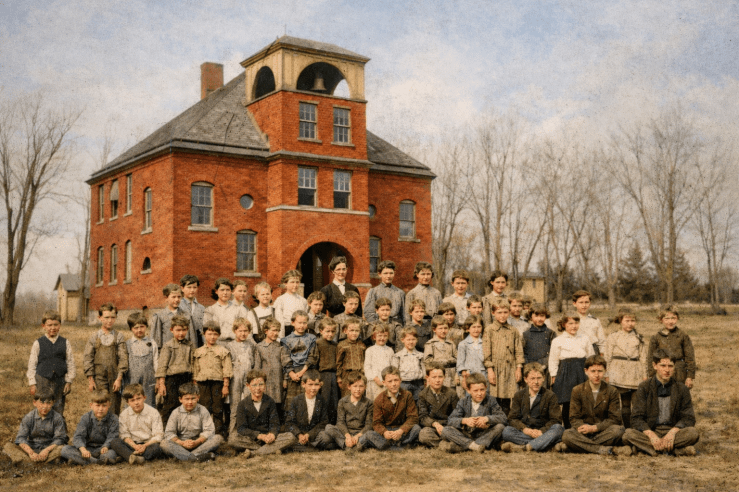
The new school — the little red schoolhouse that I became so fond of — was just two blocks from home. I would be able to walk or ride my bike back and forth.

Color rendering of the Millersburg School re-created from a historic newspaper photo.

The school itself — and many of the kids who lived there — were already familiar to me. My Aunt Evelyn — Mom’s sister — lived across the street. When I visited, she often put me in touch with the neighborhood kids, so I already had playmates when we moved there.

The school was made of red brick. It was two stories tall with a bell tower on top, though the bell had been removed before I ever walked through its doors. 

There were only two classrooms — one for grades one through three and one for grades four through six. Both classrooms were on the ground floor. 

Each classroom had only one teacher. Miss Garner was mine. The teacher for the bigger kids was Mrs. Brayton. 

Upstairs was a large room where we all ate lunch and had our music lessons. We did other things there, too, like school Christmas celebrations and sometimes a class play. 

Next to it was the kitchen and the tiny library. Sometimes when I went upstairs to get a library book, I’d stop in next door to say hello to Mrs. Archer, the cook. 

When that Monday came, and Mom brought me to school for the first time, I wasn’t nervous like I was at those other schools. I knew the streets. I knew the kids. It felt like home. 

The Icy Basement Stairs

Our farmhouse had a basement, but the only access was from the outside. The steps were concrete, but the basement itself had a dirt floor. 

One winter, the basement stairs were coated in a thick sheet of ice, too thick to be walked on. In my child’s mind, it looked like the perfect opportunity to slide down the stairs on my backside. 

So, I did. 

Once I got down there, it occurred to me that I couldn’t get back up.

The stairs were right next to the back door. I yelled for Mom. 

She couldn’t come down after me or she might have gotten hurt. So she looked around for a solution. Finding none, she stepped into the enclosed porch and brought a broom back with her. 

She extended it down to me, told me to hold on tight, and pulled me up the basement stairs. 

Being pulled up the stairs was almost as much fun as sliding down them in the first place. Having learned absolutely nothing from the first adventure, I did it again after she went inside. 

Of course, I still had no idea how to get out but, since it worked the first time, I called Mom. As before, she extended the broom to me, and hauled me back upstairs again. 

This time, rescue came with a stern look — the Mom look — and she told me not to do it again. 

I didn’t. I wasn’t about to risk getting the Mom look again. 

The Penny Jar

One summer, a teenage cousin came to stay with us for a short time to help Dad at haying time and earn a little money in the process. Let’s call him Jack. 

Since our family was using all of the bedrooms on the ground floor, Mom gave Jack one of the rooms upstairs to use while he was with us. 

Monty and I usually didn’t go upstairs, but we must have followed Mom up there when she made the bed and tidied up. That’s when we discovered the penny jar on his dresser. 

It was my brother who began teasing him that we were going to take the pennies in his penny jar when he was out helping Dad — and of course I chimed in. 

Jack didn’t seem to have much of a sense of humor when it came to his money, which made it all the more tempting to tease him. 

So, Jack told Mom that we said we were going to take his precious pennies. We weren’t of course, and Mom told him so. 

I don’t think he took much comfort in that, though. He didn’t stay very long. 

Jack is still alive, though I haven’t seen him in more than fifty years.

I sometimes wonder if he’s still guarding a penny jar somewhere — and if he’s still mad at two farm kids who never actually took a single penny.

The Little Green Basket

I have always liked baskets — or virtually anything I can put treasures in. That all started when I was a little girl.

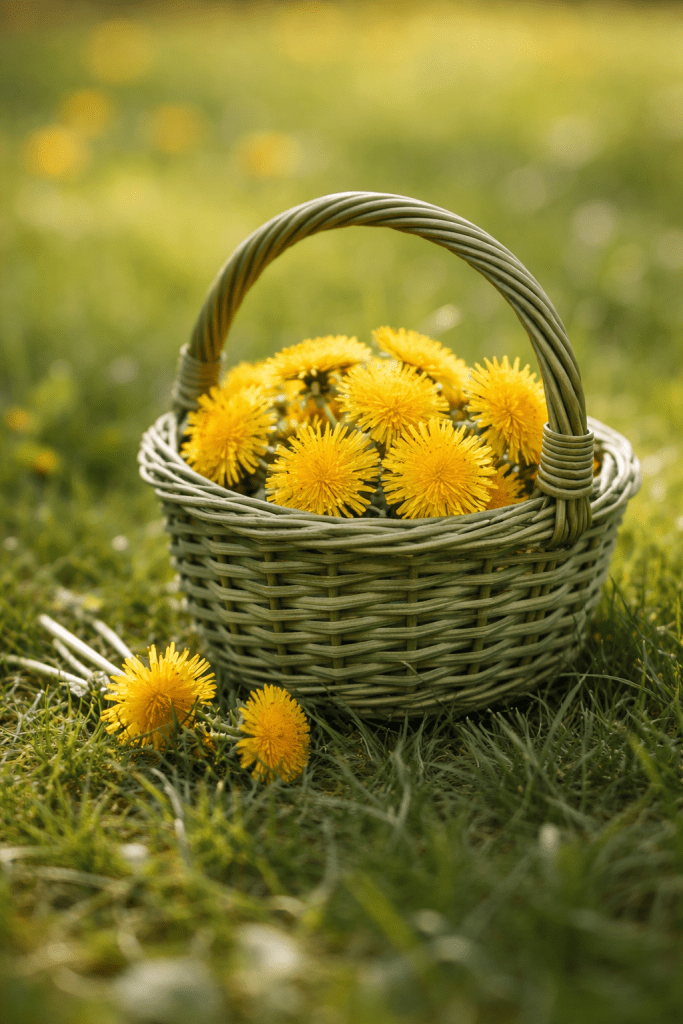
Mom gave me a small green wicker basket. Sometimes I went to the barn to gather eggs when Dad was out there, because our chickens free-ranged and liked to hang out in the hayloft. Finding their eggs was often something of an exploration, and I would usually come back with only a handful.

Other times — especially in spring or summer — I took great delight in bringing Mom baskets of dandelions, though they were usually half-closed by the time I made it back to the house.

I wasn’t allowed to roam the whole farm, nor would I have wanted to. But as long as I stayed in the yard or the adjacent barnyard, my exploring had no real limits. Sometimes I visited the rabbits in the pens Dad kept beside the barn.

By the time I brought my basket home, the dandelions had left their yellow dust on my fingers — and on my nose.

Dad used to laugh and say it was obvious I liked butter.

Barn Cat Hijinks

We had a lot of cats when we lived on the farm. Most were wild, though two or three were tame enough for me to play with. The wild ones generally stayed around the barn and didn’t come near the house except when Mom fed them.

Chaos erupted one day when one of the wild ones slipped into the house as someone opened the back door. He had never been inside before. Terrified wild-cat behavior ensued.

I remember him streaking through the house like his tail was on fire. Mom sent me into another room, but I watched from the doorway as the cat tried to escape through a closed window.

Wild-eyed, he began climbing Mom’s new sheer white curtains, shredding them as he went. She was not happy — to put it mildly.

There was no way to catch him bare-handed without inviting great bodily harm.

Careful to keep herself between me and the cat, Mom opened the door and tried shooing him onto the enclosed porch. He was having none of it.

Seeing no other solution, she grabbed a throw rug from the floor, wrapped up the cat — still clinging to the curtain — and hurled the whole furious bundle out the back door into the yard.

The curtains were ruined. It wasn’t long before we had new ones.

After his traumatic eviction, the cat was never brave enough to try the house again. In fact, I don’t remember seeing him near it after that — though Mom said he walked funny for a while.

In the Kitchen with Captain Kangaroo

Most mornings of my early childhood began in the kitchen, sitting in my little upholstered rocking chair, watching Captain Kangaroo.

The kitchen was the warmest room in the house in winter, and it was where my mother spent most of her day. While I watched television, she cooked, baked, and moved quietly around me. The air always smelled of something good. I felt safe there. Cozy. Loved.

I don’t remember the house being cold — but I suppose it must have been, especially the floors. Instead of slippers, Mom bought me a pair of ankle-high fur-lined snow boots to wear in place of slippers. She had a pair just like them in her own size. We matched. I liked that. 

Captain Kangaroo, Mr. Green Jeans, Bunny Rabbit, Grandfather Clock, and Dancing Bear felt like members of our household. They were part of my mornings, part of my growing up.

Our farmhouse had no central heating, like many rural homes in the 1950s. Two oil stoves heated the main floor — one near the bedrooms, one in the kitchen — and none upstairs, which we used mostly for storage. Winters were cold in the Midwest, and that was especially evident in our living room, caught between the two stoves. So my parents brought a television into the kitchen instead. A portable set with rabbit ears. And a child-sized upholstered rocking chair just for me.

There was a long counter along the west wall with no cabinets underneath. That became my little house. I played there for hours. Close enough that Mom could see me, far enough that neither of us would trip over the other. I didn’t know it then, but it was the perfect arrangement.

Where my mother was, I was.

And where that little rocking chair sat — that was home.

Wisdom From My Mother

I grew up with a piece of wisdom from my mother that has stayed with me my entire life.

She used to say:

“If you do the best you can with the information you have at the time, that’s all you can do.”

At the time, it sounded simple. Almost obvious. But life has a way of testing truth.

We make decisions without knowing how things will turn out.

We trust professionals.

We do what we believe is right with the facts we’re given.

And sometimes, later on, we learn things we wish we had known sooner.

That’s when guilt tries to move in.

That’s when we replay moments and ask ourselves, “What if I had done something differently?”

But here’s what I’ve learned through caregiving, loss, and ordinary human moments: You cannot punish yourself for not knowing what you could not have known. Doing the best you can with the information you have is not a failure. It is being human.

If you made a choice with care, with love, and with the intention to do right, you are allowed to forgive yourself.

You are allowed to rest.

You are allowed to move forward without carrying regret that doesn’t belong to you.

Sometimes the kindest thing we can do for ourselves is to stop judging yesterday with today’s knowledge — and let grace do the rest.

The China He Carried Home


A Young Soldier, a Promise, and a Truckload of Coal

Dad served in the European theater in World War II.

For a time, he was stationed in the Black Forest in Germany.

One day, while off duty, he discovered a small china shop. Inside, an elderly proprietor made and sold delicate white dishes, complete with tea and coffee services. Dad admired them. More than that — he already knew exactly who they were for.

He asked what it would cost for two full sets. One for his mother. One for the woman he hoped to marry someday.

The old man shook his head sadly. He had no coal to fire his kiln. Wartime shortages made it impossible.

Dad asked a simple question.

“If I bring you the coal, will you make them?”

The old man agreed. A deal was struck.

Along with his other duties, Dad sometimes drove officers from place to place. That meant he had access to the motor pool. He put his plan into motion.

Later, with a grin, Dad told me he had “borrowed an Army truck and liberated a truckload of Army coal.”

Then he laughed — because he always did at that part.

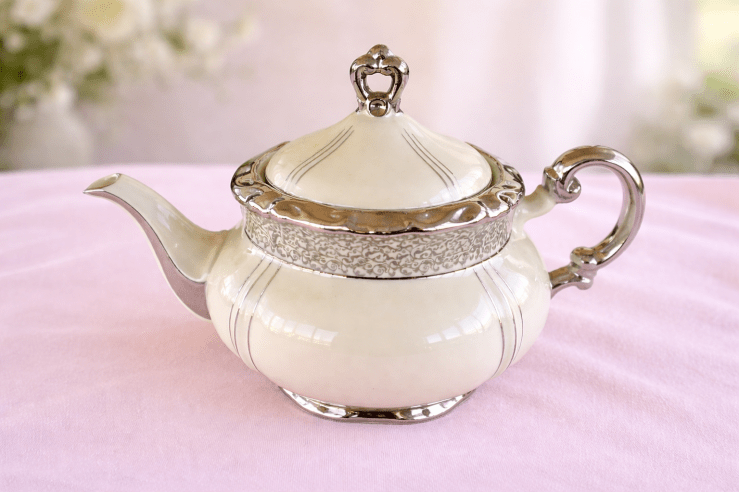
Not long afterward, two beautiful sets of white china with silver trim were finished.

One went to his mother.

Two years later, when he married mine, he placed the second set in her hands.

Today, that china sits in my care.

A quiet reminder of love, war, and a young soldier who knew exactly what mattered.

Dad Measured My Backside

Our farmhouse sat on top of a hill. The yard and driveway sloped gently down to the gravel road that passed our house and connected the community. That hill, and everything on it, shaped my early childhood. 

In the front yard were two trees. One was a tall pear tree, but I only know that because I heard my parents say so. I’m not sure what the other one was. It was broader and had a long limb that someone had hung a porch swing from — the kind that several people could sit in. I liked it and sat in it from time to time, but I couldn’t really swing — my legs were too short. 

Mom and Dad decided I needed a swing of my own, one that was just the right height for my short little legs to reach the ground. 

One sunny afternoon, they announced that today was the day I would get my new swing. I was so excited!

Dad gathered the materials — a rope, a board, a hand saw, and a drill. When he had everything together, he called us outside. I watched as he tossed the ends of the rope over the limb of the pear tree, then secured them in place. 

Next, he told me to turn around and bend over. I didn’t question it — grownups always knew what they were doing — so I did.

“I have to measure you to make sure I cut the board wide enough,” he said. He didn’t use a measuring tape. He just held the board up behind me. 

Mom told me many years later that what I didn’t see was the grin on his face and the wink he gave her when he said it. 

I loved that swing. Since the yard sloped, I felt like I was swinging a lot higher than I actually was because of it.