Thirty Years and a Lunch Bucket

Dad walked into the East Moline Works of International Harvester one Monday morning carrying his black lunch bucket with the silver latches—the kind with the domed lid that held his Thermos of coffee in the top. 

He didn’t work there. His last job had ended, and he was looking for a new one. He  told Mom he would be back when he found one.

International Harvester was a big employer in our area. Getting a job there could easily become the start of a career. 

Dad walked into the plant manager’s office. When it was his turn to be called inside, the plant manager offered him a seat and asked him why he was there. 

“I’m looking for a job,” Dad said. “I’ll do any job, no matter what it is. I’ll sweep floors if that is all you have.”

The manager listened, then shook his head and said, “I’m sorry, but I don’t have anything for you. We aren’t hiring.” 

Dad stood and thanked him, then left the office—but he didn’t leave the plant. He took a seat in a chair just outside the manager’s office. 

When the day shift ended at 3:30 pm, Dad left to find something to eat. At night, he slept in the car. He returned at 7 am the next morning when the day shift began, lunch bucket in hand.

He continued this routine for most of the week.

Dad said the plant manager began giving him odd looks as he went in and out of his office. Later that week, he stopped and asked Dad, “You’re still here?”

“Yes, and I’m going to be here until you give me a job.”

Dad said the manager shook his head and walked away. 

The next day, the manager approached him with a broom in his hand. 

He handed it to Dad and simply said, “Start sweeping.”

Before the day was over, Dad had his ID badge and was an official employee. 

Dad swept floors for a few days but was soon promoted to machinist, a job he held for over twenty years. He fed sheets of metal into a machine, making parts for combines and other equipment. 

As he neared retirement age, Dad developed some health issues, so they gave him a job as a fork truck driver. 

Eventually, Mom and Dad relocated to East Moline so Dad wouldn’t have the nearly 75 mile round trip to and from work every day. They were fortunate to locate a home just outside the entrance to the plant. 

When I was in my late thirties, International Harvester hosted an open house, inviting the families of their employees to attend. 

Dad said they cleaned for days to get the plant ready.

Our whole family attended. Dad showed us around and explained what his job was. It was amazing how many processes those sheets of steel went through before they became finished pieces of farm machinery.

It made Dad’s stories about the different jobs he performed in the space of a day easier to understand. 

I was impressed. The machinery Dad was helping to build was so much bigger and more complex than the simple machinery he had back on the farm. 

The open house answered questions I had wondered about for years. 

“What was it like where Dad worked?” 

“What did he do there?”

Of course, he had shared what it was like, but that isn’t the same as seeing it for myself.

The next day, I wrote a letter to the plant manager thanking him for allowing me to see what I had always wondered about as a child.

He didn’t answer me, but I didn’t expect him to. 

However, I was surprised the next time I saw Dad. He grinned, and handed me a copy of the company newsletter. 

They had printed my letter verbatim thanking them for the open house and telling them about the questions it had put to rest for me! 

I was so surprised! And it was obvious that Dad was proud something I wrote was chosen for the company newsletter.

Dad retired at age sixty-six, after a career that spanned thirty years. 

The lunch bucket was retired, too. 

A short time later, he stopped by to visit with his foreman. They shared a good laugh when his foreman told him they had given his job to two younger men—because one couldn’t keep up.

I can picture him laughing with a twinkle in his eye when his foreman told him that, because it happened every time he told the story afterward. 

That was my Dad. He was an exceptionally hard worker, always focused on the job at hand, and doing it to the very best of his ability. 

When I was growing up, I didn’t think too much about why he worked, other than the fact that it was just something that fathers did. 

Now I realize he did it all for us—to give our family a nice home, plenty to eat, and the kind of loving home life we enjoyed growing up.

I know it couldn’t have been easy, but he did it anyway. For us. For thirty years. 

Because that is just who he was. 
Princess the Kitten Thief

“The kittens are missing again,” Liz called as she came into the house from the backyard.  

“How many did she steal this time?”

“All of them.”

This happened on a regular basis, so she didn’t need to say more. I knew exactly who the kitten thief was. 

Princess. 

It was always Princess. 

One by one she carried the kittens across the yard and tucked them in with her own. 

She didn’t rest until she had them all.  

We had various animals, and a lot of them happened to be outdoor cats. 

They earned their room and board by keeping the mice population down in the barn, which also helped keep them out of the house.

We usually had two or three mama cats. It wasn’t unusual for them all to have kittens about the same time. 

Princess was the most maternal of them all. 

She had her own brood, of course, but she didn’t seem to be satisfied with that, so she gathered up all of the other kittens and put them with her own. 

The result was one large, sleepy kitten pile, with Princess lying down trying to nurse them all.

We didn’t really mind. It was clear that she loved them all and they were in no danger from her. 

The thing I always marveled at is that the other mama cats didn’t seem to mind. I don’t recall them trying to take the babies back, but Liz always redistributed them to the proper mama.

That usually lasted for a short time, but soon there was a communal kitten pile again. 

I always wondered what the other mama cats thought when Princess stole their babies. 

It was probably something like, “I’m free! I’m free!”

The “Lazy” Bread Baker

My mother taught me to bake bread more than 50 years ago.

My first few loaves were less than perfect. Some were dense and heavy. Some had holes in them.

With each loaf, I learned something. I learned to make sure my yeast was fresh and my water was just the right temperature. I learned what it meant to let the dough double before shaping the loaf and how to make it entirely by hand.

As the years passed, I discovered bread machines which were advertised to take most of the work out of bread making. 

What magic is this?

So, I bought a bread machine, and eagerly tried it—but I was disappointed with the outcome. It did not come out as soft as the bread my mother taught me to make. 

Not wanting to waste the money, I continued to use it, still disappointed with the result, until I hit on an idea. 

I placed the ingredients in the bread machine the night before and  set the timer to start mixing it the next morning. When I woke up, all I had to do was shape the dough and put it in a loaf pan, let it rise again, and bake it. 

Now, the bread came out just the way I wanted it to. The bread machine did all the mixing and kneading, let the dough go through its first rise, and then kneaded it once more. That let me finish the bread the way my mother taught me, giving it the soft crust I remembered.

Mom’s method is simple. As soon as the bread comes out of the oven, I butter the top. I let it rest in the pan, place a paper towel on top, then cover it with clean potholders and dish towels to keep the heat and moisture in the loaf. I let it cool in the pan before cutting it. Cutting it while it is warm makes it dry out faster.

Sometimes waiting is hard when the family is eagerly waiting for a warm slice, especially if I have some fresh homemade jam.

Every loaf I bake reminds me that my mother’s way is still part of mine. Sometimes the best results come from blending the old with the new.

Who Am I? I Was Her All Along.

I began writing this blog to leave behind family stories for my children and grandchildren.

My writing unfolded chronologically, weaving my stories together with memories of my family and the stories they told me. 

In considering the header for the blog, I wanted one that honored those stories and my voice.

I had a vision for a roll-top desk, but that alone wasn’t quite right. Something was missing. 

Then I came across a nature scene.

It made me stop and take a quick intake of breath. 

And in that moment, something shifted.

This is who I am.

The little girl who grew up on a farm.

The little girl who always had a passion for words from a tender age. 

The little girl who discovered a desire to write in grade school, but didn’t know how to get started. 

Over the years, I’ve tried to answer that question—who am I?—more than once. The answers were usually measured by roles.

  • daughter
  • friend
  • student
  • wife
  • mother
  • crochet designer
  • grandmother
  • editor
  • caretaker
  • widow
  • writer

But none of those, standing alone, ever told the whole story.

They were all true—but they were not the beginning.

The beginning was the farm.

Now I understand why.

It isn’t the place I’m holding onto.

It’s her.

That little girl, living on a farm with her mom and dad and her brother.

She isn’t just part of my story.

She is me.

Grown now.

Shaped by years of living—by love, marriage, children, profound loss, and learning to live again.

And now, by writing.

But still her.

Her story—my story—isn’t over.

There are many tales left to tell. 

The Night the World Turned Color

One afternoon when we came home from school, Mom told us that Nellie Briggs, our landlady who lived next door, had invited us over to watch Bonanza the following Saturday night. 

She had just purchased a new color television. 

Bonanza was one of our favorite TV shows, and we knew that it was now broadcast in color. It was hard to imagine since we were used to seeing it and all other television shows in multiple shades of gray.

I was so excited! I could hardly wait for Saturday night to come around. 

When the time came, we walked across the two connected yards between our homes. We stepped up onto her front porch and knocked. Nellie welcomed us and ushered us into her living room. 

And there it was. The television was larger than ours. The screen was set behind a thick glass front with rounded corners.

Mom and Dad exchanged pleasantries with her, while Monty and I sat quietly in our chairs, anxiously waiting for the show to begin. 

Finally, it came on—and I was instantly mesmerized. 

It was almost like walking into a magical world, color replacing the tones of gray that I was used to. I couldn’t take my eyes off of it.

After the show ended, we sat in silence for a few moments, and then the adults started discussing the program.

I was so enchanted by the colors that I barely remembered what the show was about. 

Soon, it was time to go home again. My parents said their goodbyes and thanked Nellie for inviting us over. 

We walked home, but I barely remember anything that came later. All I could think about was the color. 

It would be another fifteen years before I would have a color television of my own, but I never forgot that night at Nellie’s and how special it was to me. 

By today’s standards, the color probably wouldn’t seem remarkable. But to a little girl who had only known black-and-white television, it felt magical.

Waiting For the Bus in a Snow Cave

High winds, bitter cold, and swirling snow greeted us that morning as we stepped out the back door and began the walk to the bus stop at the end of our long driveway.

It was clear the walk was going to be rough. The high winds made it hard to keep our footing. 

We could tell there was a lot of snow in the driveway from the house. But our house and Nellie’s were side by side, so it wasn’t until we rounded her house that we got the full effect of it. 

The driveway was bordered on either side by wire farm fencing. It was full of snow to the tops of the fence posts, captured there by the fences themselves. 

The snow depth was almost as high as I was tall at eight years old.

In sharp contrast, the fields on either side of  the lane were windswept. 

To get to the bus stop, we had to climb up on top of the snow which, thankfully, had an icy crust strong enough to support us without breaking through.  

We could hear the wind as it skittered snow in waves across the frozen fields and the empty ribbon of highway. 

We were FREEZING by the time we got to the bus stop, the wind in our faces all the way, tiny stinging projectiles of snow assaulting every bit of our exposed skin. 

That’s when we noticed the storm had formed a snow cave in the ditch by the highway. 

The cave was big enough for us to fit inside if we crouched down. 

We ducked inside it and realized that it blocked most of the wind. It didn’t make it any warmer, but it was a relief to get out of the wind. 

Monty was a foot taller than me. He was able to see over the  tops of the drifts, so he positioned himself by the mouth of the cave so he could pop his head out occasionally and see if the bus was coming. 

Missing the bus meant missing a day of school. And neither of us wanted to try to explain that to Mom. 

After waiting about 15 minutes, the bus finally came. 

I have sometimes wondered what the bus driver thought when he saw two children suddenly pop up out of the ditch as he approached. He wouldn’t have been able to see the snow cave because the opening was facing away from the road. 

We scrambled onto the bus and were relieved to finally be inside where it was warm and out of the weather.  

On returning from school that afternoon, the wind had calmed down some, but we still had that long walk home. 

This time, we thought it might be easier walking through the field, so we jumped over the fence and walked home through the field. 

Since there was no gate on the side of the field where it bordered our house, we had to climb the wire fence when we got home. That wasn’t easy to do with frozen hands and bulky snow boots. 

The drive remained blocked for several days, so we had to repeat that walk to and from the bus daily. 

It was hard for Dad, too. Since the driveway was blocked, he had to park the car by the highway and walk home. It might have been harder for him, though, because he had to walk to the car and home again in the dark.

After Mr. Parkinson, the farmer who farmed the ground for Nellie, dug his own long drive out, he finally was able to clear our driveway. 

Many years have passed since then, and I have lived through a lot of harsh Illinois winters. But I have never seen another driveway fill completely to the tops of the fence posts or form a crust so hard we could walk on it without breaking through.

And I have certainly never waited for a school bus in a snow cave again.

The Accidental Casserole

A Note From The Porch

It was a typical busy late afternoon. Carl and Scott were home from work, and I was in the process of starting dinner. 

I gathered the ingredients together, which included a forage into the garage where our overflow pantry and freezers are located. 

I came back to the kitchen and started assembling dinner. 

Mom always made sure there were at least three different things for dinner, followed up by a dessert of some kind. 

Since she is the one who taught me to cook, I did the same. It worked equally well when there were six of us for dinner as well as just for the three of us after our other three children moved out and established their own homes. 

One of the dishes we were having that night was a corn casserole, a recipe Mom had given me many years before.

After I assembled the casserole and put it in the oven, I put together the rest of the meal and began tidying up the kitchen. 

The corn casserole calls for a box of Jiffy Corn Muffin mix. I picked up the empty box to throw it away and froze. 

Emblazoned across the front of the box it clearly said Jiffy Yellow Cake mix. 

I froze, horrified by the discovery. I had just ruined dinner!

Trying to decide what I was going to feed the guys, I decided the best thing to do was to make a new corn casserole, this time with Jiffy Corn Muffin mix. It would only delay dinner by a few minutes, since it was very quick to put together. I had enough ingredients on hand. 

Less than 15 minutes later, I slid a new casserole into the oven satisfied that I had saved dinner. 

I had every intention of throwing the accidental casserole out. I couldn’t imagine anyone wanting to eat a cake with creamed corn, cheddar cheese and green chiles in it. 

Except… Carl and Scott both said they wanted to taste it. 

I thought they were teasing me at first but quickly found out they were serious. 

So I gave them each a serving, fully expecting them to take one bite and push it away.

They didn’t.

They liked it.

So, now I was curious and tasted it, too. 

I was shocked to find out it was actually good. 

We have always liked a little bit of sugar in our cornbread, so I suppose it wasn’t such a stretch to think they might like the sweetness of the cake in it. 

Fifteen minutes later, when the actual corn casserole came out of the oven, they weren’t interested in it. They had polished off the accidental casserole, so I saved the right one for dinner the next night. 

We have talked about the incident at different times over the years. The horror of what I had done soon wore off, and now I find it funny, too. 

But I never made another one with a cake mix. 

I learned several things from the incident. 

  • Mistakes are not always failures.
  • Sometimes the “ruined” thing becomes the memorable thing.
  • Family stories often come from ordinary kitchen accidents.
  • Perfection is overrated when people are laughing and eating.
  • Always read the label. Jiffy Cake Mix and Jiffy Corn Muffin Mix look remarkably alike, and you may end up with an accidental casserole of your own.

In case you are curious, I have listed the original recipe below. And if you decide to substitute a cake mix for the corn muffin mix? I won’t tell anyone. 

Corn Casserole

Prep Time: 10 minutes  | Cook Time: 45-60 minutes  | Total Time: 55-70 minutes  | Servings: 4-6 

Ingredients:

  • 3 eggs
  • ¼ cup oil
  • 2 cans creamed corn
  • 4 oz. can of chopped green chiles
  • 8 oz Jiffy corn bread mix
  • ¾ – 1 cup shredded cheddar cheese (for topping)

Instructions:

  • Preheat oven to 350℉.
  • Combine all ingredients, except cheddar cheese, in bowl, beating eggs before adding the rest. 
  • Pour into a casserole dish. Top with cheddar cheese. 
  • Bake for 45-60 minutes or until the center is set. 

NOTE: If you like a little spice, add a few jarred jalapeno pepper slices and a tablespoon or two of the liquid.

Watching Mom Crochet

Mom was sitting on the end of our black sectional sofa, the one with silver threads running through it, crocheting a doily. It wasn’t the first time I had seen her crochet—but it was the first time I really paid attention.

I sat down beside her to watch.

She was working with dark pink and forest green crochet thread, two of her favorite colors.

I wanted to understand how she formed the stitches that made the doily grow. Her quick hand movements—and the steady progress of the piece—fascinated me.

I watched her for a long time that day. And after that, whenever she sat down to crochet, I often sat beside her to watch.

I couldn’t figure out how she did it, but I wanted to learn.

She didn’t think my seven-year-old hands would be able to manage a tiny steel hook and thread, so she gave me a blue plastic crochet hook and a ball of bright pink yarn.

She taught me how to make a chain stitch. I used up most of that yarn making one very long chain.

She tried to show me how to turn those chains into something more, but I lost interest before I had much success. It would be years before I picked it up again.

Later, when I was about eleven, a friend taught me to knit in garter stitch. I made a lot of knitted headbands that year.

In my late teens, I picked knitting up again for a while—but I was never completely comfortable working with two needles.

It felt awkward.

That’s when I turned back to crochet.

I taught myself the basic stitches from a book and quickly realized that working with a single hook felt far more natural.

As I became more invested, I learned advanced techniques and began making hats, baby blankets, purses, mittens—even rugs.

Before long, I realized I could look at a finished piece and write a pattern from it.

That led to designing my own patterns.

Eventually, I became confident enough to submit them for publication.

The first few were turned down, but I was determined. Each rejection taught me something. I studied my work, paid attention to what publishers were accepting, and adjusted.

Before long, more and more of what I submitted was accepted.

That was the beginning of what became a decades-long career in crochet design.

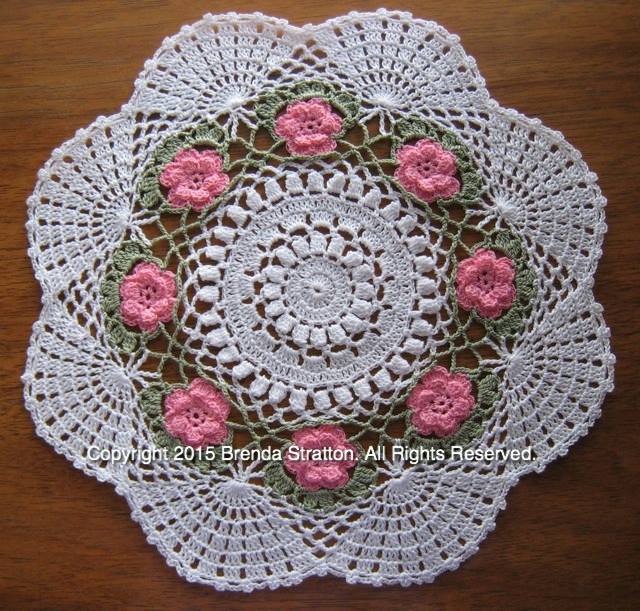
Rose Garden, a doily I designed many years later. Mom would have loved this one.

In 2004, that path led me to accept an editorial position with a Midwest craft publishing company, where I worked for several years before retiring.

I have long since lost track of that first ball of bright pink yarn—but I still have the blue plastic crochet hook Mom gave me.

Over the years, I’ve collected many hooks—favorites I reach for again and again—but none of them compare to that simple blue plastic one.

That one holds the memories.

Memories of sitting beside Mom as she worked with a tiny steel hook, creating what felt like magic out of thin air.

I’ve often told people that Mom taught me to crochet, because she was the first to put a hook in my hands.

She always gently corrected me, saying it was the other way around—that I taught her by passing along what I had learned.

Either way, she was my inspiration in crochet—and in so many other things in life.

And to think… it all started with watching Mom crochet.

Dancing With Dad

Mom and Dad met at a dance in the late 1940s, after World War II.

They loved dancing. On Saturday nights, they sometimes went out with friends. Their favorite place was the Coliseum in Davenport, Iowa—later renamed the Col Ballroom.

They especially loved waltzes and had a number of records they played at home.

We were lucky to have older cousins who could babysit Monty and me.

Eventually, they stopped going to the Col when the music shifted from Big Band to pop.

But their love of dancing never changed.

Some evenings, they would put on records and dance right there in the living room. Waltzes were always their favorite.

One evening, they set the record player on a table in the little dinette area tucked into one corner of the room.

I can still see it—the black sectional couch with silver threads running through it, the arched doorways of our mid-century modern home, the kitchen at the far end.

I wanted to dance too, but I didn’t know how.

Then, to my delight, Dad asked me to dance.

He told me to step up onto his feet—we were both in our socks. Mom put The Blue Danube on the record player, and suddenly we were waltzing around the room.

I don’t know how he made it look so effortless—especially with me standing on his feet—but he did.

The next dance was for Mom.

I sat quietly on the couch, watching them, listening to the music, taking it all in.

It’s an evening I’ve never forgotten.

The Pony and the Pig Wallow

There are some lessons you only learn once—preferably not in a pig wallow. 

I was seven when I learned that if a pony puts his head down, the rider keeps going. It was my first lesson in physics. 

One minute I was riding bareback, with nothing to hang onto but the pony’s mane. The next, I was in the pig wallow.

I did not see it coming. One moment I was upright and feeling quite capable. The next, I was flat on my back in something warm, muddy, and unmistakably pig-related.

Pig-yuck was dripping from the top of my head to my toes.

I wasn’t hurt, but I was—stunned. I had to take my glasses off so I could see, because they were covered in that same pig-yuck. 

I wasn’t far from the house, so I climbed over the fence and walked up to the back door. 

I yelled for Mom. I knew better than to walk into the house like that.

Mom came to the door. The look on her face was one of pure horror. She didn’t say much besides “What did you do?”—sort of loudly.

I tried to explain, but by then she had turned the garden hose on me…

She hosed me down starting at the top of my head, then stripped my clothes off, and hosed me down again. 

Then she wrapped a bath towel around me and carried me to the bathtub so I wouldn’t get the floor all dirty. 

By this age, I was old enough to take my own bath, but not that day. She gave me one. Then she drained the bathtub and gave me another. 

That was the last time I rode the neighbor’s pony without permission. Physics and pig-yuck are persuasive teachers.