Doctors Make House Calls

Or, at least they did in the 1950s.

I woke up one morning with a fever. Mom made me stay in bed and said I couldn’t go to school. She brought me some of my Little Golden Books and my favorite doll to entertain me. She called the doctor and made arrangements for him to make a house call later that afternoon.

I was fine with the books and my doll for a while, but I got bored. I had seen the books so many times. I don’t remember if I could read the words yet or just look at the pictures.

Before long, though, Mom brought me a new stack of books. Pearl Mohnen, the mother of the twin boys I played with across the street, had sent over some of theirs. I hadn’t seen them before, and I enjoyed them—but I noticed some had gum stuck to the covers. Boys! None of my books looked like that.

My bedroom was a stair-landing room. There was only enough space for my bed, with room to walk around it on one side. The other side was against the north outside wall. Around the staircase was a railing so no one could accidentally step off the ledge into the open stairway.

That afternoon, the doctor came. He stood on the right side of my bed, and Mom stood at the foot. He took his stethoscope out of his black doctor’s bag and placed it on my chest. I jumped—it was cold! I remember the quiet and the soft daylight in the room.

After talking with Mom, he pulled a pad of paper from his bag and wrote a prescription. Soon, he was gone again.

Mom knew she had to get to the drugstore before it closed, but we were home alone. It was cold and rainy outside, so she didn’t want to take me out—but there was no one to leave me with.

So she wrapped me in a blanket and sat me on a kitchen chair with my Little Golden Books and something with bright colored pieces—maybe her plastic clothespins, though after all these years I can’t quite be sure.

She told me she had to go get my medicine and that she would be right back. I knew where the drugstore was—it was only a couple of blocks away.

She told me not to get off the chair while she was gone.

I didn’t.

Mom knew she could trust me to do what she said—and I knew I could trust her when she said she would be right back. I wasn’t scared, but it did feel a little odd to be in the house alone.

She came right back, just as she said she would.

Autumn Leaves and Training Wheels

Leaves crunched under my feet. The tall oak trees surrounding our school were alive with color as the blue sky and late afternoon sun filtered through them. The crisp autumn air held the faint scent of burning leaves somewhere in the neighborhood.

I was six years old, and the sheer beauty of the day felt like it was wrapped around me.

We had moved into town a few months earlier. Our house and the school were only a block apart, both along the highway that ran through town.

My friend, Susie, and I had agreed to meet back at school that day. She had received a new bike with training wheels for her birthday, and she told me she would teach me to ride it. But first, we had to go home and ask our mothers if it was okay.

Mom gave me permission, but reminded me to stop, look, and listen before crossing the street—and not to cross the highway under any circumstances.

Susie met me at the school a short time later, and that’s how I learned to ride a bike.

Susie rode it first, showing me what to do.

Soon it was my turn.

At first, I just sat on the bike. Then I slowly started pedaling. It wasn’t quite as easy as it had looked when Susie rode it. The handlebars wobbled, and I felt a flicker of frustration.

But once the wheels began to move and I found the rhythm of it, the wobble settled. By the time we reached the end of the block, I was more proud than frustrated.

Susie kept pace alongside me to the other end of the block. I turned the bike around, and she rode it back while I kept pace with her.

We continued in this way for a while, until the sun got lower in the sky and we knew it was time to go home.

By then, I was pretty sure I wanted a little bike with training wheels of my own.

I crossed the street toward home, the sound of leaves still crunching under my shoes, carrying the whole golden afternoon with me.

The Hurrieder I Go, The Behinder I Get

While I was folding laundry this afternoon, I happened to think of this little cardboard sign I hung on the wall in the kitchen of my first apartment. 

I thought it was a cute saying, and would be a reminder to keep my apartment tidy. But I also liked the fact that it was printed in a psychedelic color scheme because—1970.

I currently find myself in the process of downsizing. That little quote seems just as true today as it was in 1970. It seems like the more I do, the more I find that still needs to be done. 

But, the meaning has shifted since I hung that sign so long ago. It’s not so much that I am behind now, as it is that I am just in the middle of things. 

I don’t like getting behind in my work, it’s true. I never have, especially in my professional life. 

But now, it is less clear where to start and where the middle happens, although the end is clear. I want more space and fewer belongings.

What I’m finding is that it isn’t so simple to lay the job out in a straight line like I’ve done most of my life. 

 I often find I can’t take the next step in one job because something else has to be done first.

A case in point… I live in a multi-level home. I am getting older, so I am trying to minimize the times I have to go up and down stairs every day. 

I want to create a space on a shelf to keep a few convenience foods, some things I can quickly grab for a no-fuss lunch or dinner. But before I can do that, I have to clear the shelf. 

With clearing the shelf comes deciding whether to move the items to a different location or let them go. 

Maybe I’m not getting behind after all.

Maybe there is no exact starting point.

Maybe it’s enough to just begin—wherever I am—and work my way through it, one piece at a time.

Nap Rugs and Sugar Plum Fairies

Whenever I hear “Dance of the Sugar Plum Fairies,” I am six years old again, lying on a nap rug in my first grade classroom—warm and safe.

Kindergarten wasn’t required back then, so first grade was my first real taste of school—and I loved it.

After lunch, my teacher — Mrs. Quanstrom — told us to get out our nap rugs and lie down. She turned off the lights, but the room never got completely dark. The tall classroom windows still let in the afternoon light, filtered through the oak trees that lined that side of the school.

After turning off the lights, she put a record on the classroom player. I don’t remember all of the songs she played, but “Dance of the Sugar Plum Fairies” was my favorite.

The room was very quiet except for the music. We could take a nap if we wanted to, but I was always too interested in listening.

The rug beneath me was soft. Mom knew why the teacher asked us to bring one, so she chose a rug she knew would be comfortable to lie on.

I don’t remember ever falling asleep. I was too busy listening—to the music, to the quiet, to the feeling of being exactly where I belonged.

I didn’t always keep my eyes closed, but I did most of the time. And when “Dance of the Sugar Plum Fairies” played, I could see them in my imagination.

The fairies were small and light, and they danced and twirled in the air above me.

Even now, when I hear that music, I am six years old again, lying on that soft rug in a classroom washed in afternoon light.

I am still lying on that rug.

And I can still see the fairies.

No, I never did fall asleep during nap time.

I was already dreaming.

First Grade

Around the time I first started school, I went shopping with Mom, Dad, and Monty for school supplies. I was so excited! I remembered the years when my brother went to school and I had to stay behind. Now I would never be left behind again.

When we got to the store, it was decided that Dad would help me pick out my supplies while Mom helped Monty. When everything had been chosen, Dad paid for the supplies. He was still carrying my tablet under his arm.

We left the store and had only gone a few feet when I heard him say, “Oh, no! I forgot to pay for the tablet.”

Without another word, he turned around and went back into the store — still clutching it to his chest — and apologized to the clerk for the mistake.

The only real experience I had with school before starting myself was the day I went with my brother — a memory I’ve written about before.

I can’t remember the exact first day of school. What I do remember is the school and the classroom itself.

The school was a tall, square building made of dark brick. It stood exactly one block from home. I couldn’t guess what school would be like, but I was anxious to find out.

I remember the inside of my classroom — from the wall of windows where the light filtered through the oak trees outside, to the crayon color chart on the wall with the names of each color printed in bold lettering. I remember my cubby, too. We each had one with our name printed on it to keep our nap rugs in.

We would move again before the end of the school year, but this is where I met Dick and Jane, Baby Sally and their pets, Spot and Puff. It is also where I learned that colors had names that I could write and someone else could read — and that classical music could make a child sit still and listen… and imagine.

Never Far From Home

From the summer before I started school, until the spring of my third grade year, I attended five different schools.

One place we stayed a couple of years. Three others we stayed a very short time, hardly more than a few months. In the third grade alone, I attended four different schools. I never questioned why until much later in life, when it was too late to ask anyone.

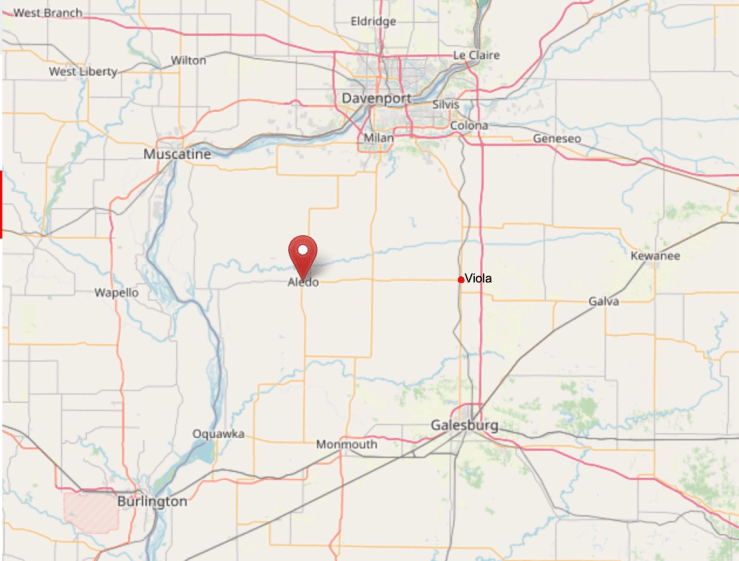
We moved from the farm, near Viola, Illinois, to Galva, Illinois, 30 miles to the east. There I started school in 1958. 

By the spring of the next year, we moved back to the Viola area, near Aledo, Illinois. I finished first grade here, attended all of second grade, but before Christmas of the third grade, we moved again, this time 44 miles west to Burlington, Iowa. I was disappointed because I had a part in the upcoming Christmas play.

I remember we spent Christmas in Burlington, but we moved again shortly after, this time 72 miles northeast to Rock Island, Illinois.

We didn’t stay long in Rock Island, either, and by spring we moved again. Our move this time took us back to my mother‘s childhood home in the small village of Millersburg, Illinois, 7 miles northwest of Aledo. 

There I would live for more than 40 years.

If you wonder why I mention the distances between towns, it is to show that we were never far from Aledo, where I was born in Mercer County Hospital in 1952 — the same hospital where my own children would be born years later. We never strayed far from our roots or our families.

My parents are gone now, so I can’t ask them why we moved so often during those three years. With the moves came job changes for Dad.

Looking back, I understand more than I did then. Those were hard years in the Midwest. Jobs weren’t always steady, and people took work wherever they could find it.

But as a child, I didn’t see any of that.

Both Mom and Dad were very hard workers — and my dad always had a job. If one ended, another one soon followed. We never went without anything. If things were tough for them, they never let us feel it.

All I knew was that we kept moving…

and somehow, we were never very far from home.

Mom, Meet Butch!

One afternoon when I was five, my mother put me down for an afternoon nap and decided to join me.

We were both sleeping soundly when we heard those words:

“Mom, meet Butch!”

We didn’t know anyone named Butch.

Mom opened her eyes.

She was face to face with an owl.

Butch the screech owl. And my brother was holding him.

Mom wasn’t amused.

It was well-known in our family that she didn’t like birds — at least not in her face. Or in her house. Or anywhere near her. Or near us kids.

She didn’t mind them from a distance, but she said they were dirty and carried mites. I wasn’t sure what mites were, but I got the idea they were some kind of crawly bug. Turns out I was right.

I don’t remember actually seeing the bird myself. I always took my glasses off when I was sleeping so I wouldn’t break them.

My brother wasn’t in the room much longer than it took to say those few words before Mom sent him scrambling back to the barn to put the owl back where he found it — cautioning him never to do that again.

Loudly.

Butch must have been a juvenile or Monty likely couldn’t have caught him. It never occurred to me to ask.

I do know Monty never brought a bird in the house again — or any other stray animal.

Sometimes I wonder if his ears were still ringing when he got back to the barn.

A Little Dab Will Do

In the 1950s, Brylcreem was as common in Midwestern households as toothpaste.

One morning while Mom was getting Monty ready for school, she was combing his hair and absent-mindedly reached for the Brylcreem. She started distributing it through his hair and realized something was different — it was thick and white and did not blend into his hair. 

Glancing at the tube she held in her hand, she discovered she had rubbed toothpaste through his hair.

What to do? The bus would be there any minute. 

I was watching them from across the kitchen. She looked at me, shrugged, and quickly washed his hair. 

In those days, we didn’t have running water. We also didn’t have hot water. What we did have was an old hand pump at the kitchen sink that only brought in cold water. Cold well water. 

Monty went to school with wet hair that morning. I expect that was the only time in his life he had his hair washed with shampoo and cold water. Brrr. 

Brylcreem, a little dab’ll do ya — that is what the television commercials said. That morning, a little dab definitely did not do. 

Two Longs and a Short

Two Longs and a Short

Party lines were a fact in the 1950s, and many rural areas didn’t convert to private lines until much later — around 1990. 

We didn’t have phone numbers in those days. We had rings. Ours was two longs and a short. 

Whenever the phone rang, everyone in the household listened carefully to see if the call was for us. When the phone rang at our house, it also rang in every other house on the party line. 

Sometimes it was hard to tell who the call was for. If you were just coming in from outdoors or another part of the house, you might not hear the entire ring.

Mom taught me the difference between our ring and those of our neighbors. I appointed myself the household sentinel to announce to the house in general — and Mom in particular — if it was indeed two longs and a short. 

The polite thing to do when answering the phone was to pick the receiver up and listen carefully for a moment to see if anyone else was already talking, then hang up if the call wasn’t for you. 

Not everyone was polite enough to follow this protocol. Some people would stay on the line and listen, a practice often referred to as rubbering. The people the call was for could usually tell someone was listening in, but only had suspicions as to who it might be. 

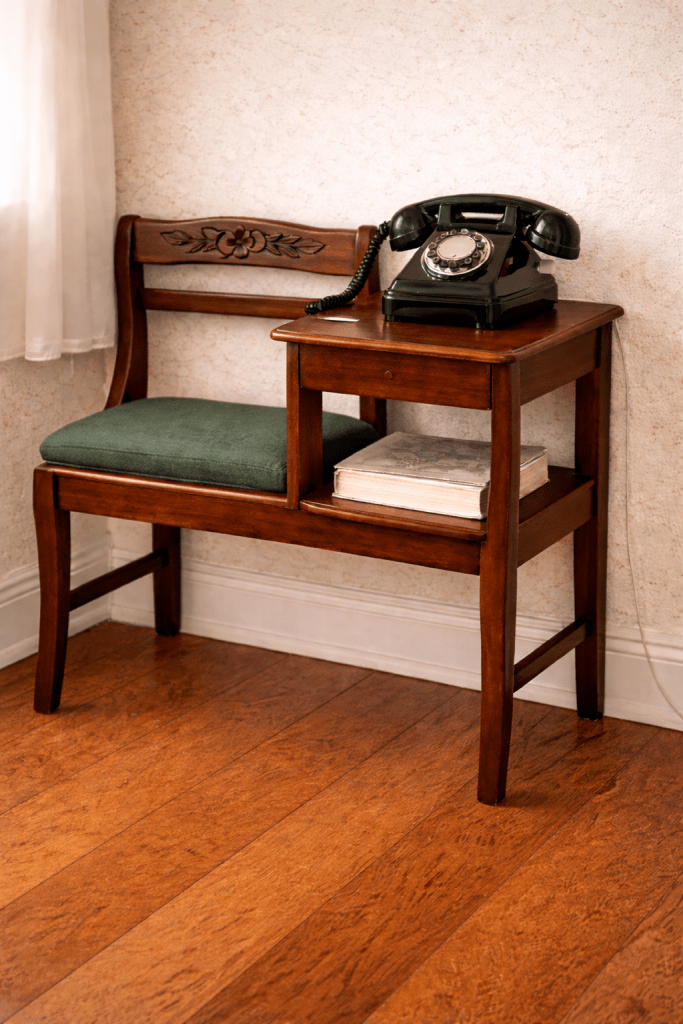
I wasn’t allowed to use the phone in those days — yet somehow, that old black box still found its way into my childhood.

It was a heavy, black desk telephone — the kind that seemed as solid as a small piece of furniture. A sturdy black base anchored it in place, and the handset rested across the top in a simple, unpretentious cradle. In the center sat the familiar rotary dial, its round finger holes lined with numbers that circled back toward you as you released them.

There was nothing delicate about it. The phone felt permanent, rooted to its spot on the phone table, as if it had always been there and would always remain. The cord, still straight then, stretched toward the wall in a quiet promise that this was not a toy, but a tool of connection — dependable, familiar, and woven into the ordinary rhythms of home life.

And when it rang, it carried its own unmistakable voice: two longs and a short, a sound that announced itself clearly and left no doubt that someone was calling.

Depression, Grief, and Healing

This piece discusses personal experiences with depression and grief.

Depression didn’t arrive all at once for me.

By the time I recognized it, it was already there.

It’s something I have struggled with at certain times in my life, which always surprised me. I have always thought of myself as a happy, easygoing person.

The hardest times came during periods when my role in life was changing.

The first time happened in my early forties. My children were growing up and no longer needed me in the same way they once had. I had been a mother for over twenty years, and that had become a large part of my identity.

This wasn’t about anything they did—it was simply a change I wasn’t prepared for. I didn’t yet know how to redefine who I was beyond that role.

It came on quietly. So quietly that I didn’t even realize what was happening until I was already deep in it.

I hurt—not physically, but somewhere deeper. I withdrew from people and from things I had once enjoyed. And when it became too much, I slept. When I was sleeping, I didn’t hurt.

Eventually, I realized something was deeply wrong. I went to my doctor and got the help I needed.

It didn’t get better overnight, but with time—and with the patience and support of my family—I found my way through it.

I learned a great deal about myself during that time. I thought I had learned enough to keep it from happening again.

For nearly thirty years, life moved along well.

Until it didn’t.

My husband, Carl, whom I had been married to for more than fifty years, became ill and passed away.

My world changed in an instant.

I believed I was grieving in a normal way, whatever that means. But over time, something else settled in.

This time, it wasn’t the same as before.

It wasn’t the kind of depression I had known. It felt different—quieter, heavier, and harder to recognize.

I didn’t recognize it. I thought I was simply moving through loss.

But looking back, I can see that I was just marking time.

I lost interest in so many things. I didn’t want to go out or see people. I let hobbies go. I withdrew into my home.

My children brought me joy—as they always have—but beyond that, I wasn’t really living.

I even stopped taking care of my health. As someone with diabetes, that is a dangerous path.

It took something unexpected to shake me out of it. A situation that forced me to stop and take a hard look at my life.

Recognizing the apathy for what it truly was became the turning point.

That’s when I began to heal.

I took a serious look at my health and realized I needed to make changes if I wanted the rest of my life to be different.

I got my diabetes under control, and in the process, I lost forty pounds.

But healing didn’t stop there.

I have always been a writer at heart. As a student, I wrote stories, essays, and poetry. Later, writing became part of my work—as a crochet designer and as an editor.

In 2025, I began to explore writing in a different way. I had so many stories in my mind—from my parents, from my life—and I wanted to preserve them for my children and grandchildren.

As I began to write those stories down, something shifted.

I found healing.

I found purpose.

I was no longer just marking time.

My life began to feel meaningful again.

And in ways I didn’t expect, that sense of purpose continues to grow.